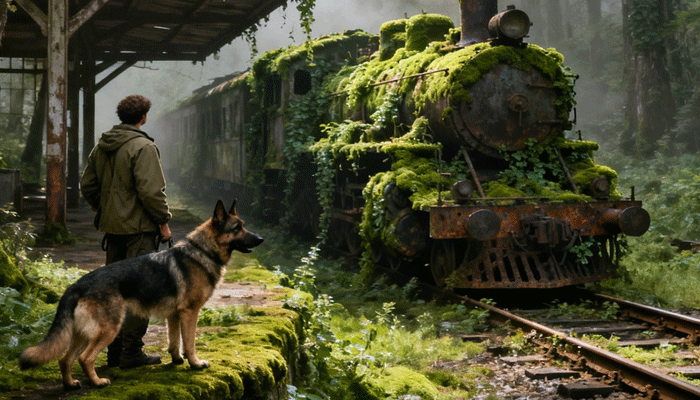
Jake Mercer had spent most of his adult life in places where silence usually meant danger.
Silence in a village outside Kandahar meant a hidden trigger beneath a pile of trash. Silence on a moonless coastline meant someone waiting behind the rocks with a rifle. Silence in the middle of the ocean, chest-deep in black water, meant the mission had gone sideways and nobody wanted to say it first.
But the silence on the sixty-three acres he bought in Black Hollow, West Virginia, was different.
It was the kind that sounded like a second chance.
The land had belonged to nobody for years, at least nobody who cared enough to keep it. The county had taken it over for back taxes. What sat on it now was one leaning barn with half a roof, a rotted fence line, and a gravel drive that looked more like a suggestion than a road. The property climbed from a creek at the front through a wide stand of oak and sycamore, then narrowed into a ridge overgrown with mountain laurel and blackberry thorns. There was no house. No neighboring lights at night. No utility lines except an old pole leaning sideways at the county road like it had given up.
Jake liked that.
At thirty-nine, with twelve years in the Navy and enough deployments to sour a man on crowds, noise, and false promises, he wanted exactly two things: room to breathe and a place where his ten-year-old daughter could stop looking over her shoulder for the life they’d lost.
Lucy sat in the passenger seat of his truck as he pulled through the rusted gate for the first time, her knees tucked up to her chest, chin resting on them. She had her mother’s dark hair, her mother’s steady eyes, and lately, her mother’s habit of getting quiet when the hurt got too large to name.
Jake parked and killed the engine.
“That’s it?” Lucy asked.
He looked out over the acreage. The afternoon light slanted gold through the trees. A creek flashed silver below. Wind moved across the ridge in long, slow breaths.
“That’s it,” he said.
She frowned. “It looks haunted.”
Jake almost smiled. “It looks empty.”
From the back seat, Ghost lifted his head.
The dog was a white-faced Belgian Malinois mix with one torn ear and the kind of stare that made strangers step back without knowing why. Jake had adopted him three years earlier through a retired working-dog program after Ghost’s handler, a Marine staff sergeant Jake knew, was killed stateside by a drunk driver. Ghost was too driven for a regular family and too sharp for anyone soft-handed. He and Jake had understood each other from the first hour. Now the dog watched the land through the rear window as if reading something the humans couldn’t.
Lucy turned and scratched behind his ear. “You think it’s haunted too?”
Ghost thumped his tail once and kept staring.
Jake opened his door. “Come on. Let’s meet our ghosts.”
They spent the first week sleeping in a fifth-wheel trailer parked beside the barn. Jake fixed the water pump, cleared brush from the drive, and ran a generator until the electric company could get a line up to the property. Lucy helped where she could, though “help” often meant reading on a folding chair while Ghost lay beneath it with his nose on his paws and one eye open.
The town of Black Hollow sat fifteen minutes away, a one-stoplight place stitched together from old brick storefronts, a diner, a hardware store, a Baptist church, and the stubbornness of people too rooted to leave. Coal had dried up decades before. Jobs now came from a lumber mill, a rock quarry outside town, and Reed Tolland, who owned just enough of everything for people to lower their voices when they said his name.
Jake met most of the town the way men like him always did: by being watched first.
At Murphy’s Diner, conversations slowed when he walked in with Lucy and Ghost’s leash looped in one hand. He was broad-shouldered, close-cropped, and carried himself like he was always measuring entrances, exits, and angles. Some folks read that as dangerous. Others read it as military. Around Black Hollow, both could earn you space.
The first person to talk to him like he belonged there was Mabel Quinn, the diner owner, a sixty-eight-year-old widow with iron-gray hair, lipstick too red for polite society, and the habit of asking personal questions as if she were doing you a favor.
“You’re the veteran bought the old Cutter tract,” she said, pouring him coffee.
“That’s me.”
“Heard you brought a little girl and a war dog.”
Lucy looked up from her grilled cheese. “His name is Ghost.”
Mabel leaned over the counter to see him through the window, where Ghost sat tied in the shade. “He bite?”
“Only people who deserve it,” Jake said.
Mabel barked a laugh. “Good. Saves time.”
Over the next ten days, Jake learned the rhythms of the place. Tom Alvarez, who ran the hardware store, would order anything Jake needed and have it in by Thursday. Pastor Glenn from the church drove a rusted Ford and minded his own business until help was needed. Teenagers fished at Miller Creek and pretended not to notice the newcomer with the scar over his eyebrow. Men in Reed Tolland’s trucks drove the county roads like they owned them.
Lucy started breathing easier. She found a flat rock at the creek and declared it hers. She named the barn cat that appeared on the second morning “Sergeant Pickles” because it glared at everyone and seemed disappointed by life. Sometimes Jake caught her laughing again, really laughing, and those moments hit him in the chest harder than any memory.
At night, after she fell asleep in the trailer bunk, he stepped outside with a cup of coffee and listened to the trees.
He told himself the land was empty.
That was before the rain.
A hard storm rolled over the ridge on the twelfth night, fierce enough to shake the trailer and rattle the dishes in the cabinets. Lightning walked across the hills. Water poured down the slope behind the barn in muddy ribbons. Ghost paced from door to window to door, restless in a way Jake didn’t like.
By dawn the storm had passed, leaving the world washed clean and smelling of wet bark and earth. Jake spent the morning checking for damage. Two fence posts were down. One section of the drive had washed out. The creek was running high and brown.
Around noon, Ghost froze.
Jake was stacking cut branches near the barn when the dog’s head snapped toward the upper ridge. No bark. No growl. Just that sudden rigid stillness that, in another life, had meant Jake’s pulse should jump first and his body move second.
“What is it?”
Ghost looked back once, then trotted uphill through the trees.
Jake wiped sweat from his neck and followed.
The climb wasn’t steep, but the undergrowth fought for every yard. Laurel branches grabbed his shirt. Briars caught his jeans. Thirty yards up, Ghost stopped at a narrow stretch of hillside where the storm had ripped away brush and topsoil. Roots hung exposed. Fresh mud slicked the ground. The dog stood over a shallow wash in the earth, pawing once, then stepping back to look at Jake.
Jake crouched.
At first he saw only rust.
Then he saw the line of rivets.
He cleared mud with both hands. Red-brown steel emerged under his fingers, curved slightly, too smooth and too straight to be natural. Another sweep uncovered a strip of faded paint, the ghost of a number beneath corrosion.
He stood slowly and looked around.
The slope on either side bulged unnaturally under trees and brush, as if the hill itself had swallowed something long and rectangular.
“No,” he muttered.
Ghost pawed the spot again.
Jake pulled a folding shovel from his belt—he’d brought it from habit, not need—and started digging.
Within twenty minutes he had uncovered enough to know what he was looking at.
A steel wall.
A boxcar wall.
He backed up, breathing hard, heart doing something strange between excitement and dread. He traced the line uphill with his eyes and saw where the ridge dipped. What he’d thought was just an old cut in the land now looked deliberate, long and narrow, like the wound left by a rail spur torn from the earth and buried over time.
The land hadn’t been empty.
It had been hiding a railcar.
“Dad?”
He turned. Lucy was forcing her way uphill behind him, Ghost having apparently gone back for her or at least failed to discourage her from following. She reached his side, saw the steel, and blinked.
“Is that…”
“Yeah,” Jake said.
“A train?”
“A railcar.”
“Why is it in our hill?”
He let out a short breath. “That’s an excellent question.”
Together they cleared more brush, enough to uncover part of a sliding door on the side of the car. The metal handle was half buried in packed dirt. An old rail tie jutted from the ground a few feet away. Below it, Jake found a rusted spike. He looked at the ridge again and started piecing it together: an abandoned spur line, a landslide or cut, decades of growth swallowing the evidence.
Lucy touched the steel with her fingertips. “Do you think there’s stuff inside?”
“Probably rats,” Jake said.
She grinned for the first time all day. “Still stuff.”
Jake should have called the county right then. Maybe the sheriff. Maybe a salvage outfit. Maybe the state, depending on what rules applied to buried railcars on private land, a subject about which he knew exactly nothing.
Instead, he kept digging.
By late afternoon, with Tom Alvarez’s borrowed come-along, a pry bar, and more effort than good sense, Jake managed to clear enough of the door track to shove the rusted panel six inches. Then twelve. Then, with a scream of metal that sent crows flapping out of the trees, he forced it wide enough to look inside.
Cold air rolled out.
Not the temperature kind. The trapped, stale, iron-tanged breath of a place shut away too long.
Jake clicked on a flashlight and swept the beam through the darkness.
Dust swarmed in the light.
The interior looked bigger than he expected, maybe forty feet long. One end had collapsed inward under the weight of soil overhead, but the center still held. He saw rotted crates, a busted lantern, lengths of chain, and what looked like a narrow cot bolted to the wall. A coffee tin sat on a crate near the middle. Someone had painted a white X on the inside panel years ago, and beneath it, faint but legible, were the words:
KEEP DRY
Lucy whispered, “No way.”
Jake stepped in carefully, boots crunching on old glass and grit. Ghost went in ahead of him, nose low, moving with the cautious certainty of a dog who knew enclosed spaces could kill you if you trusted them too quickly.
The beam found more.
A workbench made from laid planks. Shelves. An old kerosene heater. A stack of file boxes collapsed in on themselves. This wasn’t just some abandoned freight car.
Someone had used it.
“Dad,” Lucy said softly from the doorway.
Jake swung the light.
At the far wall, half hidden behind a fallen board, was a metal lockbox bolted to the floor.
He knelt, brushed away dirt, and saw the bolt heads had been cut. The box was closed but not secured. He lifted the lid.
Inside lay three oilskin-wrapped bundles, a cassette tape in a cracked plastic case, and a leather ledger swollen with age.
He picked up the ledger and opened it.
Names.
Pages and pages of names.
Property lines. Acreage. Mineral rights notations. Survey references. Handwritten signatures. Some pages stamped with the words MONARCH & OHIO RAILROAD. Others bore county seals. On the inside cover, in careful block letters, someone had written:
IF THIS IS FOUND, DO NOT GIVE IT TO SHERIFF HARLAN KESSLER. TAKE IT TO THE STATE POLICE OR THE PRESS.
Jake stared.
Lucy read over his shoulder. “Who’s Harlan Kessler?”
Jake looked at her. “Couldn’t tell you.”
But he already knew the last name.
Sheriff Dwayne Kessler’s father had worn the badge before him.
Jake closed the ledger.
The back of his neck went cold.
That evening, Reed Tolland came to dinner.
Jake had just finished reheating chili on the trailer stove when headlights rolled down the gravel drive and stopped beside the barn. Ghost was on his feet before the engine died.
“Stay here,” Jake said.
Lucy set down her spoon. “Who is it?”
“Probably trouble.”
He stepped outside as a dark green pickup door opened and a man in his mid-forties climbed out. Reed Tolland was taller than Jake expected, with a pressed flannel shirt, expensive boots, and the kind of smile that looked practiced in mirrors.
He raised one hand. “Evening. Hope I’m not intruding.”
“You are,” Jake said.
Reed’s smile didn’t move. “Fair enough. I’m Reed Tolland. Figure if a man’s going to move into my county, I ought to welcome him myself.”
“Your county?”
“The one I work in.” Reed glanced past him toward the trailer. “Heard you’ve got a little girl. Family man. I respect that.”
Ghost stood just behind Jake’s leg, silent and still.
Reed noticed him and made a point of not stepping closer. “Beautiful dog.”
“He’s not social.”
“So I’ve heard.” Reed looked up the hill. “You settling in all right?”
“We are.”
“Good.” Reed shoved both hands into his pockets. “I’m here because there’s been some confusion over your land.”
Jake said nothing.
Reed continued. “That ridge at the back? The county map on the auction listing was out-of-date. Happens more than it should. My company’s got an easement issue tied to an old access route back there. Nothing dramatic. I’d rather solve it with a check than paperwork.”
“What kind of check?”
“A generous one.” Reed named a number almost double what Jake had paid for the property.
Jake didn’t even blink. “Not for sale.”
Reed smiled again, but now it looked thinner. “You didn’t let me finish.”
“Didn’t need to.”
A beat passed.
The wind shifted through the trees.
Reed’s eyes drifted past Jake toward the slope above the barn, and for the briefest moment, something sharpened there. Calculation. Hunger. Recognition.
When he looked back, the smile returned.
“Things get complicated out here,” he said. “People think a piece of dirt is just a piece of dirt. Then they learn about title defects, old claims, state inspections. It can turn ugly faster than they expect.”
Jake folded his arms. “You threatening me?”
“I’m advising you.” Reed stepped back toward his truck. “If you change your mind, call the number on the card.”
He set a business card on the trailer step and got in without another word.
Jake watched the taillights disappear down the drive.
When he bent to pick up the card, Ghost gave a low growl from deep in his chest.
Jake looked at the slope behind the barn.
So.
Reed Tolland already knew.
The next morning Jake drove to Black Hollow’s tiny public library, a brick building attached to the courthouse by an enclosed walkway that smelled faintly of bleach and old paper. Lucy sat beside him at one of the wooden tables while he spread out photocopies from the ledger he’d made before sunrise. He hadn’t told anyone but her. Not Tom. Not Mabel. Certainly not the sheriff.
The librarian, a wiry woman named Denise Barrett, adjusted her glasses and squinted at the papers.
“Monarch & Ohio,” she said. “That line shut down thirty years ago.”
“Did they run a spur through my property?” Jake asked.
“Not through it. Along it, maybe. Old Cutter tract used to border the Hollow Branch spur.” She turned a page. “Where’d you get these?”
“On the property.”
Denise looked at him over her glasses. “Doing that thing where you tell the truth in a way that avoids the important part?”
“Yes.”
“Fine.” She leaned back and thought for a moment. “You should talk to Mabel Quinn. Her husband worked on that line. And if you see the name Eli Boone, pay attention.”
Jake’s eyes dropped to the papers.
There it was. Repeated on three pages in tight handwriting.
Elias Boone, Claims Inspector.
“What happened to him?”
Denise’s expression changed.
“In town?” she said. “Depends who you ask.”
By noon Jake, Lucy, and Ghost were back at Murphy’s Diner. Mabel brought coffee for Jake, cherry pie for Lucy without being asked, and slid into the booth opposite them when she saw his face.
“All right,” she said. “What did you dig up?”
Jake studied her for a second. “Why do you think I dug something up?”
“Because men only wear that expression for three reasons,” Mabel said. “They found money, a body, or proof somebody lied to them. You don’t look rich.”
Jake pulled one photocopy from his pocket and turned it over.
Mabel stared at the name.
Her jaw tightened.
“Where did you get this?”
“On my land.”
She glanced toward the window, then lowered her voice. “You need to listen very carefully. Eli Boone wasn’t just a railroad man. He was collecting records. Deeds. Royalties. Fraud claims. Back in the eighties, families up and down this valley signed mineral leases they didn’t understand because Tolland’s father and a few friends at Monarch & Ohio told them it was the only way to keep their land. Some lost everything. Some signed nothing and got forged anyway.”
Jake said, “And Eli Boone?”
“He found proof.” Mabel looked at Lucy, then back at Jake. “He told too many people he was taking it to Charleston. Then one night he disappeared. Sheriff Harlan Kessler said Boone ran off with railroad money. Half the town knew that was nonsense, but knowing and proving are different things.”
Lucy spoke up quietly. “Do you think he hid the papers?”
Mabel’s eyes moved to her. “Honey, if you found Eli Boone’s records, a lot of folks are going to start acting scared.”
Jake leaned back in the booth. “Reed Tolland offered to buy my land last night.”
Mabel didn’t look surprised.
“No,” she said. “He offered to bury your problem.”
On the drive home, Jake said very little.
Lucy watched the hills roll past her window. “Are we in danger?”
He kept both hands on the wheel. “I don’t know yet.”
“That means yes.”
He glanced at her and saw Claire in the shape of her mouth when she said difficult things plainly.
“It means I’m taking it seriously,” he said.
When they got back, Jake hiked straight to the railcar with a pry bar, a camera, fresh batteries, and Ghost at his side. This time he searched like the operator he used to be, methodical and unsentimental.
The cot had been built from salvaged boards and bolted brackets. Beneath it he found a rusted thermos, two .38 shell casings, and an envelope of photographs wrapped in wax paper. The photos showed county maps, stacks of documents spread across the workbench, and one grainy image of a man in a denim jacket standing beside the boxcar door. He was lean, dark-haired, maybe in his forties, with a wary face and a railroad badge clipped to his chest.
On the back someone had written: E. Boone, Oct. 3.
Farther down, the floor sounded different under Jake’s boots.
He crouched, tapped the boards, then pried up a section near the far wall.
Underneath was a cavity about three feet deep.
And inside it lay a skeleton.
Lucy gasped from the doorway. Ghost went rigid, nose quivering.
The remains were curled on one side as if the person had been pushed in and had no room to straighten. A railroad badge lay near the rib cage. The denim jacket had rotted to threads. One arm bone was broken. The skull bore a dark, ragged hole above the right eye.
Jake didn’t swear often in front of Lucy.
He did then.
He covered the cavity again and turned to her. “Out.”
“But—”
“Now, Lucy.”
She obeyed.
Jake stood in the center of the railcar for a long second, breathing through the old metallic air.
He had his answer.
This was no forgotten relic buried by chance and time alone.
It was a crime scene.
He photographed everything, bagged what he safely could without disturbing the remains, and before sunset drove to the sheriff’s office in town.
Sheriff Dwayne Kessler was in his fifties, wide-bodied, red-cheeked, and smelled faintly of cigarettes and aftershave. His office wall held a framed photo of his father in uniform. Jake noticed it before the man even sat down.
“What can I do for you, Mr. Mercer?” Kessler asked.
Jake placed one photo on the desk. Then another. Then a copy of the ledger cover.
Kessler’s face didn’t change much, but his right hand stopped moving.
“Found a buried railcar on my property,” Jake said. “There are human remains inside.”
Kessler leaned back. “You call the coroner?”
“I came to the sheriff.”
“Well,” Kessler said slowly, “that was probably a mistake.”
Jake said nothing.
Kessler tapped the ledger copy with one blunt finger. “You know how old these stories get around here? Every ten years some fool decides his granddaddy got cheated and wants to dig up the county over paperwork nobody can verify.”
“There’s a dead man on my land.”
“There’s old bones in these hills all over. Mines caved in. floods. hunting accidents.”
“This one was shot.”
That earned a pause.
Kessler’s eyes lifted to Jake’s. “Where exactly is this railcar?”
Jake held his gaze. “I’ll give you the location when state police arrive.”
The sheriff’s expression hardened. “You saying you don’t trust local law?”
“I’m saying the dead man left instructions not to trust Harlan Kessler.”
Silence settled hard between them.
For two seconds Jake thought Kessler might go for the drawer on the right side of his desk.
Instead the sheriff smiled, and that was worse.
“You should’ve stayed in the Navy, Mr. Mercer,” he said softly. “This county doesn’t take kindly to outsiders coming in and accusing dead men.”
Jake stood. “I’ll expect state police by morning.”
Kessler didn’t answer.
Jake was halfway to the door when the sheriff said, “A little girl on a lonely property… ought to make a man careful what battles he picks.”
Jake turned so fast the chair legs scraped the floor.
Kessler raised both hands, eyes cool and flat. “That wasn’t a threat. That was neighborly advice.”
Jake left before he put the man through his own desk.
By the time he pulled into the drive, the sun was gone and the first thin line of fear had become certainty.
He parked beside the trailer and stepped out with Ghost.
Something was wrong.
The barn door stood open.
Jake drew the pistol he kept locked in a safe under the truck seat and moved low toward the building. Ghost stayed glued to his leg.
Inside, the generator was still there. The tools too. But someone had taken Jake’s fuel cans, dumped them on the dirt floor, and written a message across the inside wall in black spray paint:
SELL THE LAND
Lucy was standing in the trailer doorway, pale and angry.
“I didn’t go inside,” she said before he could ask. “I remembered what you said.”
He nodded once, relieved enough to feel weak for half a second. “Good.”
She looked at the wall behind him. “Was that for us?”
“Yes.”
Ghost stalked into the barn, sniffed every corner, then returned and stared toward the woods above the ridge.
Jake followed his gaze.
Whoever had done it had come from up there.
That night Jake did what good fathers and dangerous men both do when the world becomes simple again: he made a plan.
He moved Lucy from the trailer to the cab of the truck parked behind the barn, where she could sleep if needed and be gone in seconds. He mounted two battery trail cameras on trees overlooking the drive and upper ridge. He backed up every photo and document from the railcar onto a hard drive and a cloud folder. He called an old teammate, Vince Rourke, now an investigator with the West Virginia State Police in Charleston, and left a message that started with the sentence, “If you still owe me for Norfolk, I’m collecting.”
Then he sat at the small trailer table while Lucy colored in a notebook and Ghost slept under the bench.
“You can take me to a motel,” Lucy said without looking up.
Jake blinked. “What?”
“In town. If you’re going to do dangerous stuff.” She switched crayons with great seriousness. “I know when adults lie, Dad.”
He rubbed a hand over his face. “I’m not planning dangerous stuff.”
“You always say that right before dangerous stuff.”
He stared at her for a moment and then laughed despite himself, a tired laugh pulled from somewhere buried deep. Lucy looked up, saw it, and smiled too.
“I’m not sending you away,” he said.
“Okay.”
“But tomorrow you stay close.”
She nodded, then hesitated. “Mom would say we should leave.”
Jake felt that one hit.
Claire had been the brave kind, not the reckless kind. A nurse. A woman who knew exactly how fragile the body was and loved people anyway. She’d been dead eighteen months, and still sometimes he reached for thoughts of her like they were tools hanging where he left them.
“She probably would,” he said.
Lucy looked down at her notebook. “Would she be right?”
Jake took a long breath.
“No,” he said finally. “Because somebody’s been getting away with this for a long time. And because I’m tired of men like that thinking fear is a deed they own.”
The phone rang at 11:14 the next morning.
Vince Rourke’s voice came through rough with sleep and annoyance. “You only call me when things are bad or funny. Which is it?”
“Bad.”
“Good. I’m too old for funny.”
Jake gave him the short version.
Vince didn’t interrupt until the end. Then he said, “Take nothing else out of that railcar. Photograph everything. I’m coming with a forensic team, but it’ll take a few hours to push it through because Kessler already reported you as a trespassing lunatic chasing railroad ghost stories.”
Jake smiled without humor. “Of course he did.”
“Also,” Vince added, “you’ve got company. Plate from a Tolland Aggregates truck was logged two miles from your property around dawn. Don’t be stupid until I get there.”
Jake hung up and looked out the trailer window.
A black SUV was parked at the county road below the gate.
Reed Tolland stepped out and leaned against the hood like he had all day.
Jake told Lucy to stay inside with Ghost.
Ghost refused.
Jake compromised by keeping the dog at heel as he walked down the drive.
Reed wore sunglasses this time. “Sheriff says you’ve been telling stories.”
“Sheriff says a lot of things.”
Reed nodded toward the ridge. “This is where you get practical. There’s old junk up there that doesn’t belong to you. Let my people remove it. You keep the money. Your girl gets a nice house somewhere paved.”
Jake stopped six feet away. “You seem very interested in what’s on my land.”
Reed took off the sunglasses. His eyes were pale and empty as river stones.
“My father spent thirty years cleaning up mistakes this town wasn’t strong enough to survive. Men like Eli Boone come in thinking paperwork matters more than payroll. More than jobs. More than whether families eat. He was going to burn this valley down for the sake of signatures.”
“You killed him?”
Reed smiled once, almost sadly. “I was sixteen.”
“Then your father did.”
Reed’s jaw flexed. “You know what your problem is, Mercer? You still think truth wins because it ought to. That’s military thinking. Clean lines. Good men and bad men. But out here, truth is whatever feeds your people.”
Jake leaned closer. “My people are a ten-year-old girl and a dog. And both of them have better morals than you.”
The smile disappeared.
“You think because you wore a uniform you’re harder than the men in these hills,” Reed said quietly. “You’re not. You’re just newer.”
Jake heard the engine before he saw it.
A pickup came down the road fast, braked hard by the gate, and Tom Alvarez jumped out with a pump shotgun cradled casually in one arm.
He looked from Reed to Jake. “Everything all right?”
Reed stepped back, the performance returning to his face. “Just welcoming a neighbor.”
Tom raised his brows. “Do it from farther away.”
For the first time, Reed looked genuinely irritated.
He put his sunglasses back on, climbed into the SUV, and drove off without another word.
Tom watched until the vehicle disappeared. Then he glanced at Jake. “Mabel told me enough to know you’ve dug into old trouble.”
Jake said, “You didn’t ask questions.”
Tom shrugged. “Questions make men choose sides before they’re ready. Figured I’d come stand where I was.”
That afternoon, the first trail-cam alert hit Jake’s phone.
Two men in hoodies had crossed the upper ridge at 3:07 a.m., heading toward the railcar.
One carried bolt cutters.
Jake forwarded the images to Vince, Tom, and an email address Mabel had scrawled on a napkin for a reporter in Charleston she trusted more than most preachers.
By sunset, clouds had gathered low and dark over the valley. Another storm was coming.
Vince texted at 6:12 p.m.: Delayed. Road closure. Earliest midnight. Stay put.
Jake read it twice.
He didn’t like midnight.
He liked less what came next.
At 7:03 p.m., every light on the property went out.
The generator coughed once and died. Then the trailer power cut too.
Lucy looked up from the table. “Dad?”
Jake was already moving.
Outside, the world had gone blue-black with storm light. The main power line at the pole by the road swung loose, severed cleanly. Not wind. Cut.
Ghost erupted into barking at the same moment Jake heard footsteps in the trees behind the barn.
“Truck,” he snapped.
Lucy ran.
Jake killed the truck’s interior light as soon as she climbed in. “Lock it. Do not open this door unless you hear my voice.”
“What about you?”
“I’ll be right here.”
It was a lie good enough for the moment.
He moved around the far side of the barn as rain started to spit through the leaves. Ghost went ahead, low and fast. A figure broke from the tree line and sprinted toward the trailer. Another circled wide left.
Jake hit the first man hard enough to knock him sideways into the mud. The second swung a crowbar. Jake ducked, drove his shoulder into the man’s ribs, and felt cartilage give. Ghost launched at the first attacker’s forearm with a snarling snap that ended in a scream.
“Drop it!” Jake shouted.
The crowbar hit the ground.
Headlights exploded across the upper slope.
A third vehicle.
Not from the road.
From behind the ridge.
Jake dragged the first man up by the collar just long enough to see his face. It was one of Reed’s quarry foremen, a man Jake had seen twice in town.
“Who’s up there?” Jake barked.
The foreman spat blood. “You’re too late.”
A diesel engine roared.
Jake looked uphill.
An excavator’s boom rose over the ridge like the neck of some steel animal, backlit by lightning.
They were going for the railcar.
Jake shoved the foreman down, tied both intruders’ hands with paracord from his belt, and ran uphill with Ghost beside him.
Rain hit full force halfway up.
Mud sucked at his boots. Branches whipped his face. Behind him, he heard Lucy’s voice from the truck—distant, furious, uselessly brave—and kept moving.
By the time he reached the cut in the ridge, the excavator had already torn away half the brush covering the boxcar roof. Reed Tolland stood beside the machine in a rain slicker, one hand on the cab door, the other holding a pistol pointed loosely toward the ground.
Sheriff Kessler stood next to him.
Of course he did.
The boxcar door hung open. One of Reed’s men was hauling the lockbox out into the rain.
Jake stepped into the clearing.
“Put it down.”
Kessler’s head snapped toward him. “Mercer, you are making this worse.”
Reed just looked tired now. “You should’ve taken the check.”
Lightning ripped across the sky, turning all of them white for an instant.
Jake took another step. “State police are on the way.”
“Maybe,” Reed said. “Maybe not. But this hill won’t be here when they arrive.”
He nodded to the excavator operator.
The boom started to move.
Ghost bared his teeth.
Jake said, loud and clear, “You kill Eli Boone too?”
The operator hesitated.
Kessler barked, “Shut him up.”
Reed stared at Jake across the rain. “My father killed Boone because Boone wouldn’t understand what sacrifice looks like when you’re responsible for a whole county.” His voice rose, sharp with old anger. “Do you hear me? A whole county. Men had jobs because of what we did. Families stayed fed because we kept the leases intact. Boone wanted headlines. My father made a choice.”
Jake kept his face blank even as his pulse hammered.
In his left hand, down by his thigh, his phone recorded every word.
“And you?” Jake said.
Reed’s mouth twisted. “I learned from him.”
Kessler realized it half a second too late.
“Reed—”
That was when Ghost moved.
The dog launched straight for Reed’s gun hand. The pistol fired once into the dark. Reed screamed and stumbled backward. Kessler drew on instinct, and Jake hit him low, driving both men into the mud as the excavator operator panicked and jerked the controls. The steel bucket slammed into the side of the railcar with a screech that echoed down the ridge.
Shots cracked from below.
Not at Jake.
Overhead.
“STATE POLICE!” a voice thundered through the rain. “DROP YOUR WEAPONS!”
Floodlights cut through the trees.
Vince Rourke came up the slope in a rain jacket with four troopers behind him, weapons trained, faces hard. Tom Alvarez was farther back, one hand on Lucy’s shoulder, holding her behind a tree where she was supposed to stay but clearly had not.
Kessler froze under Jake’s grip.
Reed, bleeding from the hand, tried to run.
Ghost hit him again at the knee and dropped him into the mud.
Vince’s voice carried across the clearing. “Reed Tolland, Dwayne Kessler, you are under arrest. Don’t make me say it twice.”
For a few seconds, only the rain moved.
Then it all broke open at once.
The next three weeks felt less like living and more like watching the valley turn inside out.
Forensic crews dismantled the railcar section by section. They confirmed the remains were those of Elias Boone, missing since 1984, killed by a gunshot wound and concealed beneath the false floor. The lockbox held original deeds, forged lease copies, cash ledgers, and three cassettes. On one of them Boone had recorded a message naming Harlan Kessler, Owen Tolland—Reed’s father—and two railroad executives in the fraud scheme. On another tape, voices in the railcar argued about moving “the body” and “keeping the spur buried until the county signs off.”
The third tape was mostly static.
But it held enough.
Charleston media descended on Black Hollow like crows on a cut field. So did attorneys. So did men in clean boots who had never before set foot in the town but now spoke passionately about justice into camera lenses.
Families came forward with stories. Old people carried yellowed envelopes from dresser drawers and cried over signatures they’d never written. Men who had spent thirty years calling themselves unlucky learned that some of their bad luck had names and bank accounts attached to it. The state opened investigations into land transfers, mineral leases, wrongful deaths, and official misconduct reaching back four decades.
Sheriff Kessler resigned in handcuffs.
Reed Tolland was denied bail after the prosecutor played the phone recording from the ridge in open court.
Tom Alvarez became something like a local hero for showing up when it mattered, though he hated the attention and threatened to hide in his stockroom until the news vans left. Mabel Quinn went on television twice and enjoyed every second of it, especially the part where she looked directly into the camera and said, “A valley remembers who starved it and who fed on the hunger.”
Lucy went back to breathing easier.
That mattered most.
One evening in early October, after the leaves had started their turn to red and copper, Jake sat with her on the tailgate beside the barn and watched the sunset lay gold across the ridge where the railcar had been excavated. The state had taken the main body of it for evidence, but one cleaned side panel remained propped under a tarp for preservation. Someone said a museum in Charleston wanted it. Someone else said Black Hollow should keep it as a memorial.
Ghost lay at their feet chewing contentedly on a stick the size of a fence post.
Lucy swung her legs. “Do you think Mom would’ve liked it here?”
Jake looked out over the land.
The creek flashed below. Tom’s new fence posts stood straight at the drive. A concrete slab had been poured where the house frame would go up next month. Sergeant Pickles the barn cat stalked through the weeds as if personally supervising all reconstruction.
“Yeah,” Jake said. “I think she would’ve liked the view.”
Lucy nodded.
After a minute, she said, “I was scared that night.”
“So was I.”
She turned to him. “Really?”
He laughed softly. “Lucy, I was terrified.”
She seemed to consider that. “You didn’t look terrified.”
“That’s because parents are professionals.”
That got a grin.
The county eventually offered to buy back the upper ridge, citing historical significance and ongoing legal access. Jake refused. Then they offered an easement arrangement with a conservation payment and full protection of his title. That he accepted, mostly because Vince told him the paperwork was finally clean enough to frame.
The lawsuits would take years. The criminal cases longer than they should. Some families would get money. Others would get apologies too late to mean much. Nothing would return Elias Boone to the people who had loved him, if any remained. Nothing would undo the decades Black Hollow spent being told hardship was destiny when much of it had been engineered.
But truth had done what truth sometimes does, even when men like Reed Tolland spend fortunes to bury it.
It had survived long enough to be found.
And found it was by a dog who trusted the ground less than his human did.
On the first cold morning of November, Jake took Lucy and Ghost up to the ridge before school. Frost silvered the weeds. Their breaths hung in the air.
At the edge of the excavated cut stood a temporary wooden marker the town had put up while they argued over something more permanent. Carved into it were five words:
ELIAS BOONE TOLD THE TRUTH
Lucy read them aloud.
Ghost sniffed the base of the post, then looked up at Jake as if checking whether that solved the matter.
Jake crouched and rubbed the dog’s neck. “Good work, partner.”
Ghost leaned into his hand with quiet satisfaction.
They stood there for a while in the pale morning light—one man, one little girl, one scarred dog, and a patch of West Virginia earth that had finally given up what it knew.
When they walked back downhill, Lucy slipped her hand into Jake’s.
“Dad?”
“Yeah?”
“I’m glad the land wasn’t empty.”
Jake looked at the ridge, then at the house frame rising beside the barn, and finally at the road beyond the gate that no longer felt like an exit route.
He squeezed her hand.
“Me too,” he said.
And for the first time since Claire died, the future did not feel like something he had to survive.
It felt like something he could build.
THE END