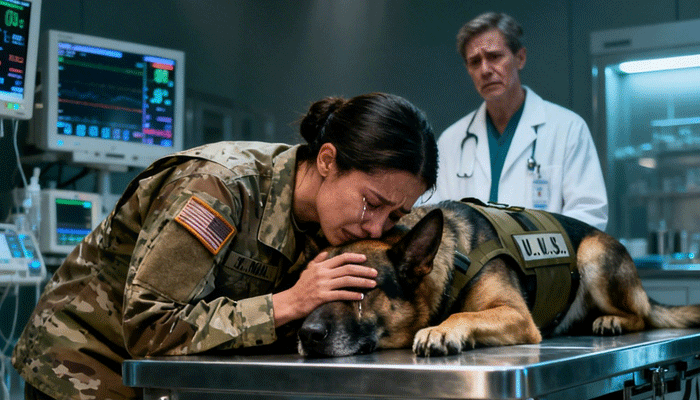
A K9 Wrapped His Paws Around His Handler Before Euthanasia—Then the Vet Found the Device No One Could Explain
Lieutenant Mason Cole had spent eleven years in uniform, and nearly nine of them with Atlas.
People in the department used to joke that the Belgian Malinois understood Mason better than most humans did. It was not completely untrue. Atlas knew the difference between Mason’s tired silence and his angry silence, between the long exhale that meant stand down and the short one that meant watch the door. He knew when Mason was trying to act brave in front of rookies, and he knew when the brave act was all Mason had left.
On the street, Atlas was legend.
He had tracked missing kids through rain-soaked alleyways, found a fugitive hiding beneath insulation in an attic, and once held a gunman at bay for seven full minutes until SWAT breached the room. He was fast, disciplined, and fearless without being reckless. Every handler in the K9 unit admired him. Every criminal in the county had heard of him.
And now Atlas was lying on a steel table beneath fluorescent lights, his breathing uneven, his amber eyes dull but still locked on Mason’s face.
The room smelled like antiseptic and cold metal.
Mason stood beside the table with both hands pressed to the edge so hard his knuckles looked white enough to split. He had not slept in thirty-six hours. His beard had grown in rough and uneven. His uniform shirt was wrinkled. His wedding ring, though he had been divorced for three years, still rested in the tray by the sink where he always left it before putting on gloves for training. He no longer wore it, but he had not sold it either. Some habits didn’t know when to die.
Dr. Avery Bennett stood near the counter reading the file for the third time.
She had been the department’s consulting veterinarian for four years, and in that time she had seen shattered joints, knife wounds, bullet grazes, heatstroke, chemical exposure, and panic so severe in retired working dogs that they chewed through drywall. But this was different. The file said Atlas had become unstable. Aggressive. Unpredictable. Dangerous. It said he had lunged at a deputy during transport. It said his neurological decline was accelerating. It said euthanasia had been recommended after failed treatment and review.
Recommended.
The word sat in Avery’s head like a stone.
“Are you sure?” she asked quietly, looking up.
Mason did not answer at first.
He stared at Atlas instead.
Two weeks earlier, Atlas had been fine. Tired, maybe. Slower than usual on the obstacle course. He had hesitated once before entering a dark storage unit, which Mason had dismissed as soreness from age. Then came the tremors. The glassy stare. The sudden episodes where Atlas seemed not to recognize commands. Three days ago, during a transport from the training yard to the vehicle bay, Atlas had snapped and nearly bitten Deputy Flores—something he had never done, not once, in nine years.
Internal review had moved fast. Faster than Mason could think. Faster than he could argue.
“Medical decline with public safety risk,” Captain Hargrove had said. “You know the policy.”
Mason had known the policy.
He also knew the dog on that table.
“He’s suffering,” Mason said at last, though it sounded like he was trying to convince himself. “And if he hurts somebody…”
His voice broke.
Avery closed the file.
Atlas lifted his head a fraction at the sound.
The dog’s ears twitched weakly. His chest rose in a shallow breath. A tremor passed through his front leg and faded.
Avery had examined him an hour earlier. Elevated heart rate. Periodic muscle spasms. Pupils slow to respond. An old scar along the lower right abdomen that Mason said came from a fencing puncture two years ago during an apprehension in a scrapyard. The department records backed that up—mostly. But the scar looked wrong to her. Too straight. Too neat. Not quite surgical, not quite accidental.
And there had been something else. Under the skin, barely noticeable, a faint hardness where soft tissue should have been.
She looked again at the file. It listed anti-inflammatory meds, sedatives, and an antibiotic trial from the department clinic. No full imaging had been done. No outside neurology consult. No biopsy.
For a dog scheduled to die in twenty minutes, too many things remained unasked.
“I want one more X-ray,” Avery said.
Mason blinked. “What?”
“One more image. Maybe two.”
He looked exhausted enough to sway. “Dr. Bennett, with respect, the department already—”
“I know what the department already did.” Her voice was calm, but there was steel under it. “I’m the one signing the final order. I’m not doing that while something about this doesn’t sit right.”
Mason dragged a hand down his face. “If this is about giving me hope—”
“It’s about facts.”
Silence gathered in the room.
The monitor near the wall hummed softly. Somewhere beyond the door, a tech rolled a stainless tray across tile.
Atlas shifted.
Then, with effort that seemed to come from some deep and stubborn place, he lifted both front paws and pressed them against Mason’s chest.
Not a scramble. Not a reflex.
An embrace.
Mason froze.
Atlas leaned forward from the table and rested his head against Mason’s shoulder, one paw hooked awkwardly around the back of his neck. It was clumsy because of the weakness in his limbs, but unmistakable. The dog had done this only twice before—once after Mason came back from a funeral for a fellow officer, and once in the empty living room on the night Mason’s ex-wife moved the last box out of the house.
Atlas made a low sound in his throat, not quite a whine.
Mason’s face crumpled.
He wrapped both arms around the dog and bowed his head into Atlas’s fur. “I know,” he whispered. “I know, buddy. I know.”
Avery took one step closer—and that was when she saw it.
Under Atlas’s short tan coat, just above the old scar, a tiny ripple moved beneath the skin.
Not muscle.
Not tremor.
Something linear. Mechanical almost. A brief shift, then stillness.
Avery’s stomach turned cold.
“Don’t move him,” she said sharply.
Mason looked up, eyes wet and confused. “What?”
Avery was already pulling gloves from the box. “Hold him steady.”
She ran careful fingers along the dog’s abdomen. Atlas tensed, then gave a small shudder. Beneath the scar, there was a firm object about the length of a finger joint. Smooth-edged. Fixed, but not bone. She pressed lightly above it.
Atlas flinched hard.
Avery’s gaze snapped to Mason. “How long has that been there?”
He frowned. “I don’t know. I never felt anything. I mean, that scar—”
“This isn’t scar tissue.”
Mason stared at her. “What is it?”
Avery didn’t answer.
Because she did not know.
But she knew one thing: whatever it was, no one had put it in the file.
Within eight minutes Atlas was in radiology.
Mason stood outside the lead shield window, shoulders drawn tight, watching Avery and her tech position Atlas gently on the table. The dog was sedated but not fully under. Avery refused to induce deeper anesthesia until she knew what she was dealing with.
The first image appeared on the screen in grayscale shadow and bone.
Avery leaned in.
Then she went completely still.
There, nestled near the abdominal wall but connected by a thin filament leading upward toward the lower thoracic region, was a metallic object no larger than a cigarette lighter’s ignition core. Not veterinary hardware. Not anything that belonged in a police dog. It had smooth casing, two wire-like extensions, and what looked disturbingly like a micro-actuator embedded near a nerve junction.
The tech inhaled sharply. “What the hell is that?”
Mason was already through the door before Avery could stop him.
He looked at the image, then at her.
For a second he seemed not to understand what he was seeing.
Then all the color drained from his face.
“That wasn’t there,” he said.
Avery kept her eyes on the screen. “It’s there now.”
“No,” he snapped, stepping closer. “I mean it wasn’t ever supposed to be there. He’s had routine scans before. Annual physicals.”
“Then either it was missed,” Avery said, “or someone never reported it.”
Mason’s jaw clenched so hard a muscle jumped in his cheek. “What is it?”
Avery zoomed in.
The filament traced toward the spine like a parasite made of wire.
“I don’t know yet,” she said. “But I know this much: Atlas should not be euthanized. He should be in surgery.”
The room turned silent again, but this silence had changed shape. It was no longer grief waiting for permission. It was danger.
Mason looked back at the image, the disbelief in his eyes slowly hardening into something else.
Fear.
“Can you remove it?”
Avery hesitated. “Maybe. But before I do, I need to know whether it transmits, tracks, shocks, releases drugs, or all of the above.”
Mason’s phone rang.
The name on the screen was Captain Hargrove.
He answered on speaker without taking his eyes off the image. “Sir.”
“Mason, I was told the procedure hasn’t happened yet.”
“It’s not happening,” Mason said.
A pause. “Excuse me?”
“They found something in Atlas. Some kind of implanted device.”
On the line, Hargrove said nothing.
Too long.
Mason noticed. Avery noticed too.
Finally the captain spoke, his tone measured. “Then secure the dog and transfer him to county veterinary research. I’ll handle it from here.”
Avery frowned. “Research?”
Mason looked at her, then back at the phone. “Why county research?”
“Because this is now evidence, Lieutenant. Follow orders.”
Avery stepped toward the phone. “Captain, with respect, I am the attending veterinarian. The dog is symptomatic and unstable. If that device is affecting his nervous system, transfer could kill him.”
Another pause.
“Doctor,” Hargrove said, voice colder now, “I said I’ll handle it.”
The line clicked dead.
Mason lowered the phone slowly.
Avery met his eyes.
Neither of them spoke, but the same thought had already landed between them.
Hargrove knew something.
They moved fast after that.
Avery transferred Atlas into the clinic’s small surgical prep room rather than the holding kennel, locked the outer access door, and shut off the automatic intake log so no external network pinged Atlas’s location. It was not standard procedure. It was also not standard procedure to discover an unidentified implant inside a decorated police K9 minutes before euthanasia.
Mason called the one person in the department he still trusted completely: Sergeant Lena Ortiz, internal affairs by title, street cop by soul. She answered on the second ring.
“If this is about Atlas,” she said, “I’m already hearing noise.”
“I need you off the record.”
“That bad?”
“Yes.”
Twenty minutes later Lena arrived through the rear employee entrance wearing jeans, a gray windbreaker, and the expression of someone who had decided in the parking lot that whatever law got broken tonight would be worth it.
She listened without interrupting as Avery showed her the X-rays.
When Lena finally exhaled, it came out as a curse.
“Who’s seen this?”
“Us, the radiology tech,” Avery said. “No one else.”
“Where’s the tech now?”
“Sending him home,” Avery said. “And reminding him that speaking about active police veterinary evidence is a good way to lose his license.”
Lena nodded. “Good.”
Mason leaned against the counter, arms folded but trembling at the wrists. “Hargrove wanted Atlas sent to county research immediately.”
Lena’s eyes narrowed. “There is no county veterinary research division.”
Avery stared at her. “What?”
“There’s a contracted pathology lab. No live animal intake. No emergency research transfer.” Lena looked at Mason. “He was trying to move the dog somewhere off paper.”
Mason felt something ugly rise in his chest.
He thought back over the last month—the sudden pressure after the Harbor Point raid, the incomplete reports, the weird attitude from command whenever Atlas’s decline came up, the way two requests for specialist referral had vanished from the system.
Harbor Point.
That was where this began.
Three weeks earlier, Mason and Atlas had been deployed to a warehouse district near the river after a joint narcotics and trafficking task force tipped a storage operation. The warrant team found half the building empty, the other half scrubbed clean too fast to be ordinary. Atlas had alerted on a locked office. Inside were burner phones, ledgers, and sealed hard drives—but before evidence could be logged, shots were fired from an adjacent loading bay. In the chaos, one suspect escaped, one died, and another disappeared before booking under circumstances no one could explain.
Afterward, the case went strangely quiet.
A week later, Atlas got sick.
Lena was already pacing. “Start at Harbor Point. Who had access to him there?”
“Everybody on the breach side,” Mason said. “Task force, evidence team, K9 support. Maybe half a dozen close enough to touch him.”
“Anyone alone with him?”
Mason thought.
There had been a moment. Brief. The kind of moment you never remember until it matters.
After the warehouse cleared, Mason had handed Atlas to kennel transport while he gave a statement. But the driver got redirected to the loading area. For maybe four minutes Atlas had been tethered in the shade beside the mobile command truck.
Not alone.
With Detective Noah Weller.
Mason straightened.
Lena saw it immediately. “What?”
“Noah.” Mason’s voice sharpened. “He said he’d keep an eye on Atlas while I finished with ballistics.”
Lena stopped pacing. “Weller from Major Crimes?”
“Yeah.”
Avery looked between them. “Do we hate Noah Weller?”
Lena’s expression went flat. “I don’t trust men who smile during internal interviews.”
Mason was already pulling up old messages. “He asked about Atlas twice after Harbor Point. Said he hoped the dog wasn’t too stressed.”
“Did he have any reason to care?” Avery asked.
“No.”
That answer hung there with weight.
In the prep room, Atlas made a low restless sound.
All three turned.
Avery went to him first.
The dog was waking more fully now, sedative lightening in his system. His breathing had improved slightly, but his pupils still tracked oddly, and every few seconds a tremor passed along his flank like a current. Avery checked his vitals, then pulled the ultrasound unit closer.
“I need to know whether this thing is releasing anything,” she said.
The ultrasound showed inflammation around the implant and a suspicious pocket of fluid. Avery drew a tiny sample with a fine needle and held it to the light.
Cloudy.
Not normal.
She tested a drop on a rapid tox screen panel the clinic kept for accidental ingestion cases.
The strip changed color almost instantly.
Avery stared.
“What?” Mason asked.
She looked up, face pale. “It’s carrying a neuroactive compound.”
Lena stepped closer. “English.”
“Something that can affect the nervous system. Behavior, muscle control, perception. I’d need a full lab to identify it exactly, but whatever this is, it could explain the aggression, the tremors, the confusion.”
Mason felt sick.
“You’re saying someone did this to him.”
“I’m saying it wasn’t an accident.”
Atlas lifted his head weakly and looked at Mason.
The dog’s trust in that moment was unbearable.
Mason had put partners in the ground. He had told mothers their sons were gone. He had stood in alleys with blood drying on his boots and kept his hands steady because that was the job. But nothing in his life had prepared him for the possibility that he had led Atlas straight into this. That he had obeyed policy, signed forms, and almost let them kill the one witness who could not speak.
Lena broke the silence. “Then we’re done staying pretty about this. We need proof, chain of custody, and somebody outside Hargrove’s reach.”
“Who?” Mason asked.
“Assistant U.S. Attorney Dana Mercer,” Lena said. “Federal crossover on trafficking. She hates dirty local command almost as much as I do.”
Avery nodded once. “Call her. I’m scrubbing in.”
Mason stared. “Now?”
Avery met his eyes. “Every minute that device stays in him is another minute whatever’s inside it can damage his system. If it ruptures, you won’t need a euthanasia order. You’ll need a body bag.”
No one argued after that.
The surgery took two hours and twelve minutes.
Mason spent every one of those minutes pacing the narrow hallway outside the operating suite. Lena sat in a plastic chair with a laptop open, digging through Harbor Point personnel logs and badge access histories. Dana Mercer arrived forty-three minutes in wearing a navy coat over courtroom clothes and the kind of expression that could make elected officials sweat.
Lena briefed her in clipped sentences.
Dana listened, then asked only three questions.
“Can the implant be tied to criminal conduct?”
“Yes,” Lena said.
“Can command suppress this?”
“They’ll try.”
“Do we trust the vet?”
Avery’s muffled voice came through the door from inside surgery: “I can hear you, counselor.”
Dana almost smiled. “Good. Then we do this once and clean.”
She called a federal evidence contact, requested emergency sealed intake authority, and instructed Lena to duplicate every image and tox strip result to two encrypted drives. Mason watched all of it like a man standing outside his own life.
At last the operating room doors opened.
Avery emerged in scrubs, mask hanging loose around her neck, exhaustion carved into her features.
In her gloved hand she held a transparent specimen container.
Inside, suspended in fluid, was the device.
It was smaller than Mason expected. Somehow that made it worse.
Smooth black casing. Tiny perforations at one end. Wire leads severed during extraction. A faint serial etching along one side.
Dana stepped forward. “Can it be analyzed?”
“Yes,” Avery said. “And it gets more interesting.”
She handed the container to Dana, then held up a second sealed bag. Inside was a smaller item, no bigger than a grainy sliver of plastic.
“What’s that?” Lena asked.
Avery looked at Mason. “A data chip.”
For one stunned second no one moved.
Mason spoke first. “Inside Atlas?”
Avery nodded. “Embedded in scar tissue adjacent to the implant cavity. Deliberately concealed.”
Dana’s voice sharpened. “Meaning someone didn’t just poison the dog. They used him to hide evidence.”
Avery leaned against the wall. “The terrifying part, counselor, is that the device wasn’t just leaking neurotoxin. It was also wired close enough to the lower nerve tract to provoke pain responses and disorientation remotely or on a timer. Whoever designed this wanted behavior changes. Wanted Atlas to look unstable.”
Mason shut his eyes.
Not sick.
Not broken.
Engineered.
All so the department would do exactly what it had nearly done: put him down and erase the evidence inside him.
Atlas survived surgery, but the next twenty-four hours were critical.
Avery kept him under intensive monitoring at the clinic’s overnight unit, now guarded by two federal marshals Dana had somehow produced before midnight. The data chip went to a forensic lab. The implant went to Homeland Security technical analysis because Dana recognized the serial pattern as consistent with black-market surveillance hardware confiscated years earlier near the southern border.
By dawn, Mason had not left Atlas’s side.
The dog slept beneath blankets in a glass-front recovery kennel, an IV in one leg, shaved patch along his abdomen stitched clean. Every so often his ears twitched at Mason’s voice.
“You scared me,” Mason murmured from the chair beside him. “You hear me? You don’t get to do that again.”
Atlas opened one eye, then closed it again.
Avery came down the hall with coffee she looked too tired to drink. “His vitals are stabilizing.”
Mason stood. “Brain damage?”
“Too soon to say how much of the neurological effect was reversible. But I’m encouraged.”
“That’s doctor language for what?”
“It’s doctor language for I think he wants to stay.”
Mason let out a breath he didn’t know he had been holding.
Avery hesitated, then handed him a printed lab sheet. “Initial tox review from the fluid pocket. Synthetic nerve agent derivative—low dose, slow release. Designed to impair judgment, increase irritability, disrupt motor control. Not enough to kill quickly. Just enough to ruin a working dog.”
Mason stared at the page until the words blurred.
“You ever seen anything like this?”
“In military research papers? Vaguely.” Avery shook her head. “In a suburban police K9? Never.”
Dana arrived an hour later with news.
The data chip had been decrypted.
What it held was worse than any of them expected.
Not drug inventory.
Not ledgers alone.
Video.
Hidden camera footage from Harbor Point and two earlier locations tied to trafficking and money laundering. Timestamped clips showing off-book meetings between Detective Noah Weller, Captain Hargrove, and men already under federal watch. There were payment schedules, transfer codes, and one especially devastating video from inside the Harbor Point office showing Weller retrieving a flash drive from a safe, then turning as Atlas alerted on him from the doorway.
The dog barked.
Weller looked directly into the camera and said, “That animal’s a problem.”
Mason listened in silence as Dana described it.
Then Dana added one more thing.
“In the final clip, after the breach, your dog is tethered beside the mobile command truck. Weller approaches with a field medical kit. He kneels. The angle’s bad, but you can see him injecting or inserting something near Atlas’s abdomen.”
Mason’s vision narrowed.
Lena, standing by the window, muttered a curse that belonged in a confessional.
Dana’s eyes were hard. “We have enough for warrants. Maybe not convictions yet, but enough to start rolling people up before they can bury the trail.”
Mason looked through the kennel glass at Atlas.
The dog was still weak, still healing, still half shaved and stitched and drugged. But he was alive. Because at the last moment he had reached for Mason, and Avery had noticed one wrong movement under the skin.
One embrace had cracked open the whole lie.
The takedowns began that evening.
Dana moved with the speed of someone who knew hesitation got witnesses killed. Federal agents picked up Noah Weller at a marina outside town where he had boarded a rented fishing boat with two duffel bags and a fake passport. Captain Hargrove barricaded himself in his office long enough to shred documents, but digital subpoenas beat paper by a mile; they already had more than enough. Two evidence clerks were detained for altering chain-of-custody logs. A contracted kennel medic disappeared before dawn, which only confirmed he mattered.
The city exploded with rumor.
By morning, news vans lined the police headquarters parking lot. Anonymous sources talked about corruption. Someone leaked “implanted K9 device” to a local station, and within hours every network affiliate within a hundred miles wanted a shot of Atlas’s photo from his award ceremony three years earlier, tongue out, ears up, Mason smiling beside him like the world still made sense.
But the world did not make sense yet.
Not even close.
Because dirty cops were only one layer.
The videos on the chip hinted at something larger: trafficked migrants routed through warehouse corridors disguised as storage transfers, narcotics moved alongside electronics, payoffs reaching beyond city lines. Harbor Point was not the center. It was a spoke.
And someone still missing had designed the implant.
Three days after surgery, Atlas stood on shaky legs for the first time.
Mason was there with Avery.
“Easy,” Avery said, one hand near the harness sling under Atlas’s chest.
Atlas wobbled, leaned into Mason’s knee, and steadied.
The dog looked older now. Not in fur or face, but in bearing. As though pain had carved a hard lesson into him. Still, when Mason gave the old hand signal for focus, Atlas’s ears pricked. Slow, but present.
“That’s my boy,” Mason whispered.
Avery smiled for the first time in days. “Neurological response is improving. Some of the damage may have been chemical interference rather than permanent injury.”
Mason crouched carefully, bringing himself level with Atlas. “Hear that? You’re too stubborn to retire.”
Atlas touched his nose to Mason’s chin.
Lena entered a moment later carrying a folder. “I hate to ruin the Hallmark moment, but we’ve got movement.”
Mason rose. “What kind?”
“The missing kennel medic surfaced.”
“Where?”
“Dead.”
The word hit like a thrown brick.
Avery’s smile vanished. “How?”
“Single gunshot. Rural rest stop. Staged robbery.” Lena’s tone said she believed that explanation about as much as she believed in fairy godmothers. “Before he died, he called a burner registered to a veterinary supply distributor in Tulsa.”
Dana, who came in right behind her, picked up the thread. “The distributor is real. The invoices are not. Federal traced it to a shell company linked to a former defense contractor named Edwin Voss.”
“Defense contractor?” Mason said.
Dana nodded. “Biotech adjunct. Lost his clearances eight years ago after an internal ethics probe. Since then he’s been drifting through private security, gray-market surveillance, and God knows what else.”
Avery’s expression sharpened. “You think he built the implant.”
“We think he built a version of it,” Dana said. “And if he did, he may be building more.”
Mason glanced at Atlas.
Dana noticed. “I’m not asking for field work.”
“Good,” Avery said.
Dana ignored her. “But Atlas may still matter. Dogs remember scents, routines, patterns. If Voss handled him or the implant components, Atlas could key on something later.”
Avery crossed her arms. “Atlas is recovering from attempted murder.”
Dana’s mouth tightened. “So is half my witness list.”
Mason stepped between them before the argument could ignite. “Nobody’s using Atlas unless Avery clears it.”
Avery gave him a grateful look she tried not to show.
The next breakthrough came from the implant itself.
Homeland Security analysis found micro-reservoir channels inside the casing and a crude, compact receiver module capable of responding to short-range encrypted signals. Not military-grade, exactly—too improvised—but smart enough to operate in bursts. The implant could deliver pain, disorientation, or chemical dose increments. It was the sort of thing a monster built when he needed a weapon that looked like an injured animal.
There was also trace residue on the casing from an industrial solvent used in only a handful of fabrication shops across three states.
One of them was twenty miles outside Tulsa.
The same city tied to the fake veterinary supplier.
Dana assembled a strike team. Federal agents. State police. One technical specialist. Lena as liaison because she knew the local corruption map better than anyone. Mason was ordered to remain behind.
He did not take that well.
“I can identify Weller’s contacts,” he argued in Dana’s temporary command room. “I know how Harbor Point smelled, how the men moved, which names came up—”
“You’re emotionally compromised,” Dana said.
“My dog got turned into a disposal unit. Damn right I’m emotionally compromised.”
Dana held his gaze. “Which is why you stay here.”
He looked at Lena for support.
She shook her head once. “She’s right.”
Mason felt the anger rise hot and useless. He was used to being the one who went through the door. Used to action, not waiting. Waiting had nearly killed Atlas already.
Then Avery spoke from the back of the room.
“Take him,” she said.
Everyone turned.
Avery stepped forward slowly. “Not into the building. Not on entry. But if Voss has a workshop and there are animal traces, transport records, or chemical stores, Mason can identify K9-specific handling patterns. And Atlas—”
“No,” Mason said instantly.
Avery lifted a hand. “I wasn’t finished. Atlas doesn’t go inside. He stays mobile, in medical supervision, as confirmatory backup only if absolutely necessary.”
Dana studied her. “You trust that?”
“No,” Avery said. “I trust the alternative less.”
And so, two days later, under gray Oklahoma skies and a wind that smelled like dust and cold iron, Mason found himself standing near an unmarked command van outside an abandoned feed-processing facility while federal agents prepared to raid a building tied to Edwin Voss.
Atlas remained in a climate-controlled transport SUV with Avery beside him, heart monitor clipped, recovery harness on. He was stronger but not whole. Mason hated having him there at all.
But when he approached the vehicle before the operation began, Atlas sat up and fixed him with a look Mason knew too well.
Ready.
Waiting.
Mason rested a hand against the dog’s neck. “You do one thing for me today,” he said softly. “You stay alive.”
The breach went in at 6:12 a.m.
First team entered through the west roll-up door. Second through side office access. Dana listened to comms through an earpiece, jaw tight, one hand on the radio clipped to her vest. Lena watched the perimeter through binoculars.
“Movement, north shed,” she said abruptly.
Two men broke from a detached outbuilding and ran for a tree line.
State police intercepted one. The other fired twice and vanished between rusted equipment frames.
Inside the main facility came shouting.
Then: “Lab confirmed. Multiple cages. Chemical containment. Clear rear corridor!”
Avery looked up sharply from Atlas’s monitor. “Cages?”
Mason’s stomach dropped.
The radio crackled again. “We’ve got dogs. Repeat, multiple dogs.”
He was moving before Dana could stop him.
“Mason!”
He ran across gravel toward the open bay, body remembering old momentum before permission could matter. Two agents at the entrance recognized him and let him through after one furious look from Dana who, cursing, followed.
A K9 Wrapped His Paws Around His Handler Before Euthanasia—Then the Vet Found the Device No One Could Explain
Uncategorized tan4 · 13/04/2026 · 0 Comment
The interior smelled wrong the moment he crossed the threshold.
Bleach. Blood. hot plastic. Fear.
There were stainless work tables, hanging hoses, hard cases of electronic parts, racks of pharmaceuticals, and along the far wall, six reinforced kennels.
Three were empty.
Two held dead dogs covered with tarps.
The sixth held a living German Shepherd, gaunt and trembling, with shaved patches along its side and a collar worn so long into the fur it had rubbed the skin raw.
Mason stopped cold.
One agent beside the kennels said quietly, “We found two more in the freezer room.”
Voss’s workshop occupied the back office: microscopes, soldering equipment, veterinary sedatives, false clinical labels, and a whiteboard covered in dosing calculations. Taped to one corner was a series of photographs of working dogs from law enforcement websites around the region. Some had red Xs through them. Atlas’s picture was there too.
Mason stared at it until Lena touched his arm.
“Don’t,” she said.
On the central workbench, technicians laid out components matching Atlas’s implant.
Dana stood over them, pale with fury. “He’s been building a program.”
“What kind of program?” Mason asked, though part of him did not want the answer.
Dana looked at the kennels. “A way to turn trained service animals into disposable couriers, surveillance platforms, or liabilities. Depends what the buyer wants.”
Avery, who had come in behind them after securing Atlas with a federal medic, stepped into the room and went still when she saw the dogs.
Her eyes moved across the tables, the tools, the chemical shelves. “This is torture.”
No one contradicted her.
One surviving dog, a black Labrador with cataract-clouded eyes, was found in a back pen barely breathing. Avery knelt with it immediately, barking instructions for saline, thermal blankets, and transport crates. Whatever else she was, she was a field surgeon when she had to be.
Then a shot rang out from somewhere beyond the rear corridor.
Everyone ducked.
“Runner in tunnel!” came a shout.
Lena turned. “There’s a sublevel.”
They found the tunnel beneath a trapdoor concealed by feed pallets. It led toward the old rail spur behind the property. Agents pursued. Mason started after them, but Dana grabbed his shoulder.
“No.”
He almost jerked free.
Then Atlas barked.
Sharp. Violent. Outside.
Not random.
Alert.
Mason spun and ran back toward the lot.
Atlas was on his feet inside the SUV, ears pinned, barking toward the east perimeter. Avery had the rear door open, trying to keep him contained, but the dog’s body language had changed in an instant from recovering patient to working K9.
Mason followed the line of Atlas’s stare.
There—near a drainage ditch fifty yards out—a man in a tan work jacket was crawling through weeds toward a parked utility truck the initial perimeter had somehow missed.
Edwin Voss.
Mason knew it not by face—he had only seen file photos—but by the way Atlas knew it.
The dog’s growl came low and absolute.
Dana shouted for agents. The man heard her, twisted, and raised a handgun.
What happened next unfolded too fast for thought and too slow to forget.
The gun came up.
Mason moved.
At the same instant Atlas launched from the vehicle.
Later Avery would swear she had not unclipped him. Later Mason would say the same. Maybe someone had failed to secure the secondary latch. Maybe Atlas had forced it. Maybe sheer will had found a way through plastic and pain.
Whatever the reason, he hit the ground running.
“Atlas—no!”
The dog streaked across the gravel, surgical harness flapping, one bandaged side visible, body not at full strength but driven by something beyond it. Voss fired.
The shot went wild as Mason slammed into his arm.
Atlas reached them a heartbeat later and drove Voss into the ditch.
He did not maul.
He did not lose control.
He pinned the man exactly as trained—forelegs braced, teeth at sleeve and wrist, pressure perfect, eyes blazing.
Agents swarmed in.
The gun was kicked away. Voss screamed. Mason dropped to one knee, one hand instinctively going to Atlas’s flank, terrified of fresh blood.
But Atlas held.
Steady.
Alive.
When they finally pulled Voss into cuffs, the man looked at Atlas with naked hatred.
“That animal ruined years of work,” he spat.
Mason’s entire body went cold.
Dana crouched beside Voss. “Good,” she said.
The case detonated nationally after that.
Voss talked just enough to save his own skin and damn everyone else. Hargrove was indicted on federal conspiracy charges. Weller flipped after forty-eight hours and named buyers, routes, and cover operations in three states. The hidden program targeting working dogs unraveled piece by piece: selected animals from law enforcement, private security, and high-end protection units had been tracked, compromised, or evaluated for implantation under cover of injuries, contracted treatment, or evidence custody gaps.
Atlas had not been the first target.
He had been the first one who survived long enough to expose it.
Months passed.
Spring came slow that year, with thin green along the sidewalks and dogwood blooms outside the clinic where Atlas still went twice a week for rehab. He regained weight. The tremors faded. His coordination improved. He would never return to full tactical deployment—Avery made that clear, and Mason didn’t fight her. Some lines, once crossed, were not meant to be recrossed.
Instead, Atlas learned a quieter life.
Mornings in Mason’s backyard with a ball he no longer chased as far but still chased with dignity. Slow walks by the river. Visits to school safety programs where children sat cross-legged and listened, wide-eyed, as Mason talked about service, loyalty, and listening when something feels wrong. Atlas wore a navy vest now that read HONORARY SERVICE K9 and accepted ear scratches like a retired general tolerating applause.
Avery came by on Sundays more often than she admitted were professional.
Lena teased both of them relentlessly.
Dana sent clipped text messages that always sounded like subpoenas even when she meant congratulations.
One evening in late May, the four of them sat on Mason’s back porch while Atlas slept with his head on Mason’s boot.
The sun was slipping down behind the fence line. Somewhere a neighbor grilled burgers. Wind carried the smell of cut grass and charcoal.
Lena set her beer on the rail. “City council wants to name the new animal rehab wing after Atlas.”
Avery smiled. “As they should.”
Dana, who never really relaxed but had unbuttoned her jacket as a symbolic gesture, said, “There’s also discussion of a federal commendation.”
Mason looked down at Atlas.
The dog’s ears flicked once in his sleep.
“He doesn’t need commendations,” Mason said quietly.
“No,” Avery agreed. “But maybe people do.”
Mason thought about that.
He thought about the exam room where Atlas had wrapped tired paws around his neck. About the metallic shadow on the X-ray. About how close grief had come to becoming obedience. How easy it would have been to trust paperwork over instinct. Procedure over devotion. Authority over one last look.
He bent and rested a hand on Atlas’s side.
The dog opened one eye, then thumped his tail once against the porch boards.
Mason smiled.
“You saved yourself,” he murmured. “You know that, right?”
Avery heard him. “Not just himself.”
Later that summer, after the trials began and the headlines slowly moved on to newer disasters, Mason visited the clinic alone with Atlas for a final follow-up scan.
The images were clean.
Scar tissue, healed incision, no residual foreign body.
Avery studied the results, then set them aside. “I can’t promise he’ll never have flare-ups. But for where he started? This is remarkable.”
Mason nodded. He had learned not to ask medicine for certainties.
Atlas stood between them, tail low and easy.
Avery crouched and scratched beneath his collar. “You know,” she told the dog, “you remain the most difficult patient of my career.”
Atlas licked her wrist once.
When they stepped outside, the evening air was warm and gold.
Mason paused on the sidewalk, looking at the clinic doors, then at Avery. “You know you saved his life.”
Avery slipped her hands into her coat pockets. “I noticed a ripple.”
“You questioned an order.”
“I did my job.”
He shook his head. “A lot of people had that chance.”
For the first time, Avery did not deflect.
She looked at Atlas, then back at Mason. “He asked for help.”
Mason frowned faintly.
Avery smiled. “That hug? Maybe it was comfort. Maybe it was instinct. Maybe it was him holding on to the only person he trusted. But I’ve worked with enough animals to know this: sometimes they communicate in the one language that gets us to stop pretending we don’t see.”
Mason looked down at Atlas.
The dog gazed back, calm and bright.
No fear now. No chemicals. No hidden wires. Just presence.
On the drive home, Mason took the long route by the water.
Windows down. Country music low on the radio. Atlas resting his head between the front seats the way he always had. The city skyline ahead looked smaller than it once did, less like a system and more like a place full of people capable of either ruin or rescue depending on which voice they listened to when the moment came.
At a red light, Mason reached back blindly and found Atlas’s neck.
The dog leaned into his hand.
Some bonds were forged in training yards and gunfire and discipline. Some were forged in kitchens at midnight, in grief, in the silent knowledge that another living thing had watched you at your worst and stayed.
And some bonds were proven under fluorescent lights, minutes before death, when love became evidence and trust uncovered evil.
Mason had almost lost Atlas because men with titles counted on one brutal truth: that a dog could not testify.
They had been wrong.
Not because Atlas spoke.
Because he endured long enough for the right people to listen.
That fall, Mason officially retired from active tactical service and accepted a new role leading statewide K9 welfare and evidence-integrity reform. Lena called it “the least boring desk job in America.” Dana called it “strategic prevention.” Avery called it “a chance to make sure this never happens again.”
Atlas attended the signing ceremony of the new protection standards at the state capitol wearing his honorary vest and a medal the governor clipped on crookedly because Atlas kept trying to sniff the podium microphones.
The room laughed.
Mason laughed too.
It felt good.
After the ceremony, reporters asked what message he wanted the public to take from the case.
Mason stood beside Atlas, one hand resting lightly on the dog’s shoulders.
He thought of all the polished lies that had brought them there. All the signatures. All the sealed files. All the men who believed power meant deciding whose suffering counted.
Then he answered simply.
“Loyalty deserves loyalty back,” he said. “And when something feels wrong, you don’t look away just because the paperwork says it’s fine.”
Atlas sat taller, ears forward, as camera shutters clicked.
For once, no one in the room saw a broken animal.
They saw a survivor.
That night, back home, Mason took Atlas into the backyard under a clear sky full of stars. The grass was cool. The world was finally quiet. He unclipped the leash, though Atlas barely ranged a few feet now, and watched the dog sniff along the fence, then circle back and sit at his feet.
Mason lowered himself onto the old wooden step.
Atlas pressed in against him.
Not a command.
Not a drill.
Just closeness.
Mason wrapped an arm around the dog’s neck the way he had in the clinic, except this time there was no steel table, no waiting syringe, no order hanging in the air like judgment.
Only the steady rise and fall of Atlas’s breathing.
Only the sound of crickets.
Only a second chance, earned the hard way.
“You and me,” Mason said softly.
Atlas leaned harder against him.
And in the dark, with the worst of the past finally behind them, that was answer enough.
THE END