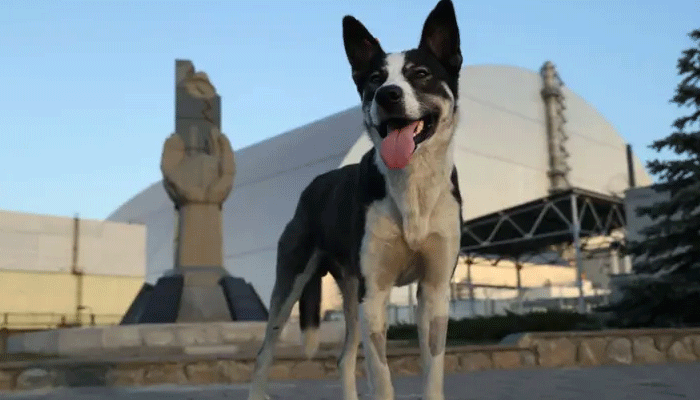
It had not been long since Bohdan arrived in the Chernobyl Exclusion Zone (the radiation-affected area) when he realized that his new job came with some unexpected companions. On his very first day as a guard at a checkpoint controlling entry into the Chernobyl zone, he was joined by a pack of dogs.
Bohdan (not his real name) has now been working in the zone for two years and has become well acquainted with the dogs living there. Some have names, others do not. Some stay close to him, while others keep their distance but come and go as they please. Bohdan and other guards feed them, give them shelter, and sometimes provide medical care. When the dogs die, they bury them.
In a sense, all these dogs are refugees of the 1986 disaster, when Reactor Number 4 at the Chernobyl Nuclear Power Plant exploded. As a result, tens of thousands of people were evacuated from the Ukrainian city of Pripyat and nearby areas, and they were told to leave their pets behind.
To prevent the spread of radioactive contamination, Soviet soldiers shot many of the abandoned animals. However, some managed to survive by hiding. Thirty-five years later, hundreds of stray dogs roam freely across the 2,600-square-kilometer (1,000-square-mile) Exclusion Zone, an area largely devoid of human activity.
No one knows which dogs are direct descendants of the abandoned pets and which wandered in later from elsewhere. But today, all of them are residents of the zone.
Their lives are harsh. They face radioactive contamination, attacks by wolves, forest fires, and hunger. According to Clean Futures Fund, a non-governmental organization working for dogs in the Exclusion Zone, the average lifespan of a dog there is only five years.
The surviving dogs of this devastated place are widely known, and some have even become famous on social media. Lukas Hixson, co-founder of Clean Futures Fund, gave up his research career to care for animals and now introduces people to the dogs virtually.
However, far less is known about the local workers who interact with these dogs on a daily basis.
Jonathan Turnbull, a PhD researcher in geography at the University of Cambridge, felt that collecting their stories would be valuable in itself.
He said, “If I want to understand the dogs, I need to speak to the people who know them best—and those are the guards.”
What he discovered was a heart-warming story of relationships between guards and animals in this abandoned landscape—one that offers a deep insight into the bond between humans and dogs.
For example, guards have given many dogs nicknames. According to Turnbull, there is a dog named Alpha, named after a type of radiation index. There is also a dog called Tarzan, who is well known among Chernobyl tourists for performing tricks on command and now lives near the Soviet-era Duga radar installation. There is also a plump female dog named Sausage, who likes to lie on warm pipes during winter. These pipes serve buildings used by workers involved in efforts to contain radiation from the damaged power plant.
Access to the Chernobyl Exclusion Zone requires permits, so guards are responsible for controlling checkpoints on roads leading in and out of the area. Those who illegally enter the restricted zone by avoiding checkpoints are known as “stalkers,” and guards report them to the police.
When Turnbull, who lives in Kyiv, began visiting the zone regularly, he met Bohdan and other checkpoint guards. At first, they were reluctant to speak with him, so he worked to gain their trust. Eventually, they agreed to participate in his research—what he described as a “turning point.” He gave the guards disposable cameras and asked them to photograph the dogs in everyday, unposed moments. In return, the guards made one request: “Please, please bring food for the dogs.” Turnbull did exactly that.
The photographs taken by the guards revealed just how close their friendships with the Exclusion Zone dogs had become.
Turnbull published some findings and images from his interviews with the guards in a journal in December. More recently, at the request of BBC Future, he conducted another interview with one of his research participants. At the guard’s request, his name was changed and he is referred to as “Bohdan.”
Bohdan says that when he patrols the deserted roads of the zone to check for stalkers, the dogs happily accompany him. They are always eager to see whether guards or tourists have brought food. He explains that if a dog strays while chasing an animal, it eventually returns to him.
This loyalty goes both ways. Turnbull notes that guards often go out of their way to help the dogs. They remove blood-sucking parasites from their skin and help vaccinate them against rabies.
Monitoring movement in and out of the Exclusion Zone can be monotonous work—but the dogs are always nearby.
At some checkpoints, guards keep dogs as semi-pets, feeding and sheltering them. However, not all are easy to handle. One guard told Turnbull during the research, “We can’t give Arka injections because she bites.”
Another guard described a dog that was even harder to manage—you couldn’t even approach her. He explained, “You just leave the food bowl and walk away. She waits until you’re gone, then eats.”
Bohdan says dogs sometimes bark at strangers at first. But if they don’t sense danger, they quickly calm down, wag their tails, and sometimes even seem to smile.
Visitors to Chernobyl are generally advised not to touch the dogs, as they may carry radioactive material. It is impossible to know where the dogs roam, and some parts of the Exclusion Zone are more contaminated than others.
Besides dogs, other wildlife also lives in the Exclusion Zone. In 2016, U.S. wildlife biologist Sarah Webster of the University of Georgia and her colleagues published a paper revealing that mammals—from wolves to wild boars and red foxes—inhabit the area. Camera-trap data showed that animal populations were not necessarily lower in highly contaminated areas.
Animals living in the Exclusion Zone are not confined to it. In a 2018 study, Webster and her colleagues tracked a wolf fitted with a GPS collar. It traveled 369 kilometers (229 miles), moving southeast, then northeast, and eventually crossing into Russia.
Animals of Conflict
Wolves, dogs, and other animals could theoretically carry radioactive contamination or genetic changes beyond the Exclusion Zone through reproduction.
Webster said, “We know this happens, but we don’t understand the scale or the intensity.”
Turnbull notes that guards are generally not overly worried about radiation, although they occasionally use dosimeters to check dogs.
Greger Larson, an archaeologist at the University of Oxford who studies the domestication of animals, says dogs give reassurance to people who spend time around them.
Although he was not part of the research, he said of the guards, “They see themselves through the dogs’ eyes. If the dog is okay, that means you’re okay.”
But in reality, this may be a false sense of security.
Turnbull said, “This is an unusual environment. You can’t see the danger. You always feel it might be there, but everything looks normal.”
Despite the potential radiation risks posed by the dogs, guards like Bohdan emphasize the benefits of having them around. He explains that dogs bark differently depending on whether they sense a human stranger, a vehicle, or a wild animal at a distance. Because of this, Bohdan considers the dogs his “assistants.”
Larson says what is happening in the Exclusion Zone echoes the long-standing relationship between humans and dogs, which dates back thousands of years.
“This has been with us for at least 15,000 years or more,” he says. “This is what people do. They form close bonds not just with dogs but with many other animals. It reflects their attachment to the place they live.”
Around the world, there are many dogs that exist in between—neither fully domesticated nor fully wild. These are the dogs that roam cities and industrial areas in search of food. People may partially adopt them but do not consider them pets.
Chernobyl’s dogs also exist on this boundary between domestic and wild. But Webster notes an important difference.
“The Exclusion Zone is unique because humans have largely abandoned it, and the only people dogs regularly see are guards,” she says. “So opportunities for bonding with humans are very limited.”
While the outside world is fascinated by these dogs and their stories, for many guards the connection is deeply personal. Bohdan says he is often asked why dogs should be allowed to remain in the Exclusion Zone.
His answer is simple:
“They bring us happiness. Personally, to me, they are a living symbol of life after the radiation disaster.”