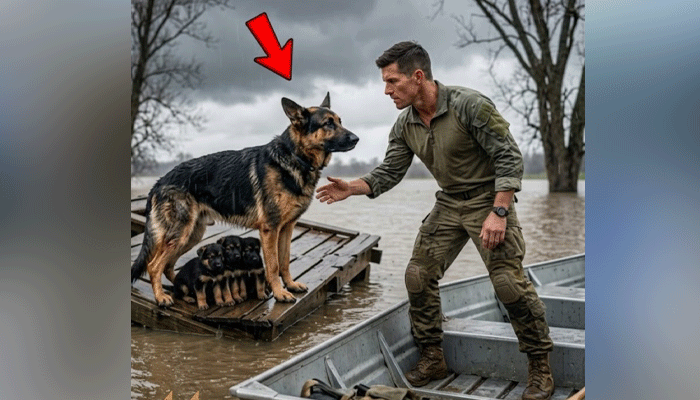
A Soldier, A Dying Bark, And The Hidden Truth Beneath Floodwaters That Someone Desperately Tried To Erase Forever
The soldier and his loyal dog followed the faint intermittent barks amidst the floodwaters that no one dared cross.
On a crumbling rooftop, a mother dog stood alone, refusing rescue, trying to protect something beneath the rising current.
The soldier plunged into the dark water again and again, pulling up fragile creatures just inches from disappearing.
But what he found below was not just puppies. A recently cut leash and a truth someone had tried to leave behind.
While the storm passed, something deeper remained. A choice between leaving or staying when it mattered moSt. Ultimately, it wasn’t strength that saved them, but loyalty, faith, and an unspoken promise.
The rain had stopped, but the land had not yet remembered how to breathe. Ash hollow, Vermont.
They stretched beneath a dull gray sky, the kind that held light without warmth. Water still covered what used to be roads.
Fences leaned like tired men. Pieces of barns, broken ladders, and plastic barrels drifted slowly in a current that no longer roared, but had not forgiven.
Three days of relentless rain had turned the countryside into something quieter and more dangerous, not chaos, aftermath.
Dorian Hail moved through it like someone who understood both. He stood at the stern of a narrow aluminum boat, one hand steady on the motor handle, the other resting loosely at his side.
He was 38, tall, about 6 ft with a lean, compact strength that didn’t ask for attention.
His face was clean shaven, sharp in structure, square jaw, defined cheekbones, the kind that caught light even under clouded skies.
His dark brown hair was cut in a military style, slightly longer than regulation, brushed back by habit rather than care.
His skin carried the pale tone of someone born in colder regions, but it had been weathered, etched lightly by wind and years spent outdoors.
His eyes were gray blue, steady, observant, and almost too quiet. He wore the same thing he always did, a worn olive gray tactical combat shirt, softened by years of washing.
The cuffs and shoulders slightly frayed. Faded, earthtoned combat pants hung just loose enough to move easily, their knees scuffed and pockets sagging from use.
Old military work boots, water darkened now, anchored him to the unstable footing of the boat, and on his wrist an old military watch, scratched but still ticking with stubborn precision.
Dorian didn’t speak much, not because he had nothing to say, but because he had learned a long time ago, that words didn’t always change outcomes.
Sometimes they only made you feel like you had tried. The motor hummed low as he guided the boat past what used to be a gravel road.
A mailbox stuck out of the water at an angle, its red flag still raised, as if waiting for a letter that would never come.
He slowed when he saw movement ahead. Not danger, just someone still trying to hold on.
An old man stood on the porch of a half flooded house, boots planted wide, one hand gripping the railing.
He looked to be in his early 70s, thin, slightly hunched, with a face carved by years of wind and quiet endurance.
His gray hair clung damply to his scalp beneath a worn cap and his flannel jacket red and faded, hung loose over a thick sweater.
There was something steady in his eyes. Not calm, not fear, recognition. The kind that came from seeing the same kind of trouble too many times.
Waters still rising north side, the man called out, voice rough but carrying. Took the old Miller place clean off the map.
Dorian nodded once. Not agreement, just acknowledgement. The man squinted toward the distance, then added quieter this time.
There’s something else, Dorian didn’t respond, but his hand eased slightly on the motor. Been hearing it since early morning, the man continued.
From the old livestock sheds up past the ridge. Not wind, not woodbreaking. He hesitated, then said it plainly.
Sounds like a dog. But wrong? Dorian turned his head just enough to meet the man’s gaze.
Wrong. How? The old man shifted his weight. Like it ain’t barking to warn, he said.
Like it’s running out of breath. Silence settled between them for a moment. Then Dorian gave a small nod and pushed the throttle forward.
He didn’t say he would check. He didn’t need to. The further north he went, the less familiar the land became.
Trees leaned at strange angles, their roots exposed like broken ribs. A section of fencing floated by, tangled with weeds and bits of fabric.
The water here moved differently, slower on the surface, but with a pole underneath that suggested depth.
Dorian cut the engine and that’s when he heard it. Not loud, not constant, but there.
A bark, if it could still be called that. Short, broken, forced. Each one separated by a breath that sounded like it hurt.
Dorian stood still, letting the sound settle into his awareness. He didn’t rush. He never rushed.
Instead, he turned the boat slowly, following not just the direction, but the pattern. Three barks, pause, two, long silence, then one, again.
There was rhythm in it, intent. He guided the boat between two partially submerged trees, and then he saw it.
A collapsed livestock structure. What remained of a wooden animal pen had been torn free from its base and carried downstream until it wedged itself between two large tree trunks.
The current pressed against it constantly, water rushing beneath and around it, but the angle held for now.
The roof, what was left of it, tilted slightly, slick with rain and mud. And on top of that unstable surface, she stood, a German Shepherd, female, midsized, but built for work, her chest strong, frame lean, but powerful beneath the soaked fur that clung to her body.
Her coat, black and tan, had darkened with water, the saddle marking barely distinguishable from the rest of her.
One ear held straight, the other flicked occasionally, nicked slightly at the edge. She was trembling, but not from panic, from exhaustion.
Her paws were spread carefully for balance, claws digging into the softened wood. Every muscle in her body looked like it had been holding the same position for far too long.
Her eyes, amber brown, deep and focused, were not scanning. They were fixed downward. She barked again, a harsh cracked sound that seemed to scrape her throat on the way out.
Then again, and again. Dorian eased the boat closer, careful not to let the current slam him into the structure.
Easy, he said, voice low. Steady. The dog turned her head. For the first time, she looked at him.
There was no wildness there, no blind fear, just calculation. She held his gaze longer than most animals would.
Then she looked away back down into the water and barked louder this time, faster.
Her front paws shifted, tapping the roof as if trying to mark a precise location.
Dorian followed her line of sight. The water below was murky, thick with debris. Small branches and bits of hay drifted past in slow, uneven circles.
At first he saw nothing, just movement, just water. Then something changed. Not a shape, not clearly, but a disturbance that didn’t match the current.
A flicker, gone as soon as it appeared. Dorian’s grip tightened on the edge of the boat.
The dog wasn’t trying to get rescued. She hadn’t moved toward him, hadn’t even tried.
She had stayed, held position, spent whatever strength she had left, not to survive, but to keep pointing, to keep marking something below.
Dorian felt something old shift inside his cheSt. A memory not fully formed, pressed against the edges of his thoughts.
A voice, a moment, a decision he had made once that had followed him longer than it should have.
He exhaled slowly. “If you’re still calling it,” he murmured, eyes on the water. “Then it’s still there.”
“And that meant one thing. He wasn’t done yet.” The dog barked again, softer now, but urgent.
Dorian killed the engine completely and let the boat drift just enough to align with the wedged structure.
The current tugged, testing, he reached for the rope, securing the boat to a protruding branch.
Then he stood still for a moment, listening not just to the water, but to the pattern.
The dog shifted her weight again, claws scraping lightly against wood. Her breathing was shallow, rapid, but controlled, trained.
Dorian’s eyes flicked briefly to her neck. No modern collar, but there, beneath the soaked fur, a faint line, worn.
Something had been there once, something official, something that meant she wasn’t supposed to be here.
All right, he said quietly. Not to the dog, not to anyone, just to the moment.
The dog looked at him again, and this time she didn’t look away. The water moved beneath them, slow on the surface, restless underneath, and whatever was down there was running out of time.
The boat drifted just enough to remind Dorian that nothing here was stable. Water pressed against the hull in uneven pulses, not violent, but insistent, like something testing the edges of his control.
The rope creaked against the branch he had tied it to. Fibers stretching, holding for now.
For now. Dorian shifted his footing, boots wet and heavy, knees slightly bent to absorb the motion.
His body moved instinctively, adjusting without thought. Years of training had carved that into him.
Balance first, reaction second, emotion last, always laSt. He extended his hand again. Come on, he said quieter this time.
The German Shepherd turned her head slowly. Up close, she was more worn than he had first realized.
Not just wet, worn. Her coat, once a clean black and tan, was dulled by mud and exhaustion.
The fur along her flank clung in uneven patches, revealing a body that had gone too long without reSt. There were faint scars, old ones, thin lines near her shoulder and along her rear leg, the kind that didn’t come from accidents.
Her chest rose and fell too faSt. But her eyes, those eyes didn’t flicker. They held steady, measuring him.
Dorian had seen that look before. Not in civilians, not in strays, in working dogs, military, search and rescue.
K9 units that were trained not just to follow, but to decide. You’re not guessing, he murmured.
The dog took one careful step forward. Her paws slid slightly on the soaked wood, claws scraping, catching again.
For a moment, it looked like she might jump. Then she stopped. Her head snapped back toward the water.
A sharp bark tore from her throat, harsher than before. She moved back to the edge of the broken roof, leaning forward, body angled downward.
Focused, Dorian followed her gaze again. This time he didn’t just look. He studied. The surface was deceptive.
Slow ripples, drifting debris. But underneath, something moved differently. Not with the current. Against it, a disruption.
Small but deliberate, gone again before he could lock onto it. Dorian exhaled slowly through his nose.
“All right,” he said under his breath. He crouched slightly, lowering his center of gravity, eyes scanning the structure more carefully now.
The collapsed pen wasn’t random wreckage. It had shape. A partial wall reinforced with the metal brackets had twisted and lodged against the trees.
Beneath the roof, something darker shifted where the water pulled deeper. The dog barked again.
Two quick bursts, then silence, then one more. Dorian’s eyes narrowed. Pattern, not panic. Signal.
You’re counting, he said quietly. The dog didn’t react to the words, but her body stilled.
That was answer enough. He moved faster now, but not rushed. He pulled the rope tighter, reinforcing the knot, then reached for the edge of the structure, testing its stability.
The wood groaned, but held under his weight. Careful. Everything here required careful. He stepped onto the submerged beam just below the roof line, one hand gripping a splintered support poSt. The current pressed harder against his legs here, pushing sideways, trying to knock him off balance.
The dog didn’t move away. She watched him, not defensive, not aggressive, watching, waiting, as if the next thing he did mattered more than anything that had come before.
Dorian lowered himself further, crouching at the edge where the water lapped against the structure.
Cold air rose from it. Not the clean cold of snow, the heavy murky cold of flood water, full of dirt, debris, and things that used to belong somewhere else.
He leaned forward, eyes fixed on the shifting surface. Nothing. Then there, a flicker again.
Not light, not reflection, movement. Small, weak, but there gone as quickly as it appeared.
Dorian didn’t hesitate this time. He pulled his shirt sleeve tighter against his forearm, flexed his fingers once, then looked up at the dog.
“Stay,” he said. The word came out automatically, a command clear, firm. The dog’s ears twitched, her body tensed.
But she didn’t move. She held position. Accepted. Dorian gave a small nod. Then he slipped into the water.
The cold hit him like a wall. Sharp. Immediate. It stole the breath from his chest before he could control it.
Forcing a quick, tight inhale that burned going down. He pushed through. It forced his body to adapt.
Vision collapsed into merc. Brown gray fragments drifting past his face. He extended his arms, fingers spread, searching not with sight, but with touch.
Wood broken. A jagged edge scraped across his knuckles. He ignored it. Reached deeper. There, something soft, then movement.
A small frantic twitch against his hand. Dorian adjusted his grip carefully. Too tight and he’d crush it.
Too loose and the current would take it. He found the shape. Small body, soaked fur, fragile, alive.
He pulled upward, kicking hard against the current. The pressure resisted, tugging at him, trying to drag him sideways, but he angled his body, used the structure as leverage, and pushed through.
He broke the surface with a sharp inhale. The dog was already there, closer than before.
Her head lowered, nose reaching toward his hands. Dorian lifted the small form carefully onto the roof.
A puppy, tiny. Its fur, once probably light, was now matted dark with water. Its body trembled weakly, chest fluttering in shallow, uneven breaths.
The mother leaned in immediately, not frantic, precise. She sniffed, then licked once across the pup’s face, slow and deliberate, checking, confirming.
Then she shifted slightly, not relaxing, repositioning. Her eyes snapped back to the water again.
Dorian followed the movement. His breath slowed. One, he said quietly. Not to her, to himself.
He glanced back at the broken structure beneath the surface. The current hadn’t eased. If anything, it felt stronger now.
The support beams creaked faintly under the pressure. Time was narrowing. The dog let out a low sound, not a bark this time.
A rumble deep in her cheSt. Different. Dorian froze. It wasn’t directed at him. It wasn’t fear.
It was recognition. Her gaze shifted, not down, but slightly to the side of where he had just come up, a new angle, a new point.
Dorian turned his head slowly. The water there looked the same, but something beneath it, something unseen, had just moved, and whatever it was, it hadn’t been there before.
Dorian’s jaw tightened. He looked back at the dog. She held his gaze, not asking, not pleading, just waiting, as if to say, “You’re not finished.
Not even close.” Dorian wiped water from his face with the back of his hand, breathing more steadily now.
His muscles were already starting to stiffen from the cold, but he ignored it. There was no space for that yet.
He shifted his footing on the unstable roof, glancing once at the rescued pup. It twitched again, still alive, still fighting.
Good. He turned back to the water. The second point, different angle, different depth, maybe.
The structure beneath him groaned again, louder this time. A warning. He didn’t have long.
Dorian rolled his shoulders once, loosening tension. “All right,” he said under his breath. Then, without hesitation, he dove again.
The water swallowed him whole. This time, he angled slightly left, following the line the dog had indicated.
His hands moved faster now, more confident. Wood, metal. A loose panel drifted past his arm.
Then a sharp edge. He caught it just in time, stopping his forward motion. Below it, something shifted.
He reached down. Another small body, weaker, barely moving. Dorian’s chest tightened. He adjusted his grip carefully, pulling it free from where it had been wedged between debris.
For a second, it didn’t react. No movement, no struggle. Just wait. Too still. Dorian kicked harder.
Up now. He broke the surface again, breath ragged this time. The dog was already leaning forward, closer than before.
Dorian lifted the second pup onto the roof. For a moment, nothing. Then a faint shaky breath, the smallest movement alive.
The mother’s nose pressed gently against it. Another slow lick. Then she shifted again. Back to the edge.
Back to the water. Dorian stared at her. Water dripped from his hair, his shirt clinging to his frame.
Cold seeping deeper now. He didn’t need to count this time. He already knew there were more.
The current surged slightly, nudging the structure. The rope holding the boat creaked again, tighter now.
Everything around them was starting to shift. Dorian looked down once more into the murky water, then back at the dog.
She didn’t move, didn’t look away, didn’t doubt. And somehow that was the thing that made it impossible for him to stop.
The third dive did not begin with courage. It began with calculation. Dorian Hail stood braced on the slanted remains of the roof.
Water dripping steadily from his sleeves, his shirt clinging cold against his skin. His breathing had slowed, but not because he was calm, because he was forcing it to.
There was a difference. The river no longer roared, but it had not loosened its grip.
Beneath the surface, the current moved with a quiet violence, pulling sideways downward, always searching for something else to take.
Dorian glanced once at the two rescued pups. They lay close together now, small bodies pressed against each other for warmth.
Their fur was still soaked, their movements weak, but there was life in them that mattered.
The mother hovered over them, not lying down, not resting. Her body remained angled toward the edge of the roof, ears shifting, eyes fixed on the water below.
She did not look at Dorian. Not anymore. She didn’t need to. He had already understood.
Dorian rolled his shoulders once, feeling the stiffness beginning to creep into his muscles. Cold had a way of settling in quietly, then taking everything at once if you let it.
He couldn’t afford that. Not here. He stepped down again toward the edge, boots slipping slightly on the soaked wood before finding grip.
The structure beneath him gave a low warning creek. Time wasn’t just passing. It was running out.
He dove. The cold hit harder this time. Not sharper, deeper. It pushed past the surface shock and settled into his limbs, dulling his fingers, slowing reaction by fractions of seconds that mattered more than they should.
Dorian forced his eyes open, even though the water gave him nothing back, dark, clouded, thick with silt.
He moved anyway. His hands swept through the space where he had felt the structure before, tracing memory instead of sight.
There the frame, metal bent inward, twisted but holding. Below it, the wooden shelf. He found it by accident or instinct or something in between.
His fingers struck the edge just as it shifted. Not violently, but enough. Enough to tell him the balance was breaking.
The current pressed against the structure again, stronger now, nudging it loose from where it had been wedged.
Dorian hooked his arm around the frame, anchoring himself. Then he reached down and felt them.
Two more, smaller than the first, closer together. Their bodies were wedged between a warped plank and the metal frame held just high enough above the rising water to survive, but barely.
One moved weakly, the other still, two still. Dorian’s chest tightened. He adjusted his grip carefully, fingers sliding beneath the first pup, lifting it free without forcing the structure to shift too quickly.
The wood groaned. He paused, waited, counted, then pulled the second. It came loose with a soft resistance, like something that had already given up trying to hold on.
Dorian kicked upward, pushing against the current, body angling toward where he knew the surface should be.
His lungs burned, not from panic, from timing. He broke through the water with a sharp inhale, dragging in air that felt heavier than it should.
The mother was already there, closer now than before. Her nose touched the first pup before he even set it down, then the second.
Her movements were faster now, but still controlled, still precise. She nudged one, then the other, her breathing quick, but measured.
The first pup twitched, a faint, fragile movement, alive. The second, nothing. The dog paused just for a second.
Her head lowered slightly. Then she nudged it again, harder. A small sound escaped her.
Not a bark, not a whine, something quieter, something deeper. Dorian watched. Didn’t move. Didn’t interrupt.
Then a breath barely there but real. The pup’s chest lifted, shallow, weak, but enough.
The mother stilled again. Then she shifted. Not away. Back toward the edge. Dorian exhaled slowly.
That’s four,” he said under his breath. But his voice didn’t carry certainty because the dog didn’t relax, didn’t settle, didn’t stop watching the water.
For the first time since he had arrived, the dog stepped away from her pups.
Not far, just enough. She moved along the roof, paws careful, body low. Then she stopped at a different point.
Not where he had just come from, not where the others had been. She looked down, then back at him.
And in that look, there was no urgency, no panic, no command, just something else, something quieter, heavier.
As if what remained below was not just something to save, but something to understand.
Dorian felt it before he could explain it. A shift, not in the water, in the moment.
He moved toward her slowly, following her position. The structure beneath them creaked again, louder now.
The current surged once, pushing against the trapped beams. Dorian crouched at the new edge, looked down.
Nothing. Then his hand brushed against something submerged near the surface. Not fur, not movement, solid.
He reached again, gripped it, pulled. A length of metal chain surfaced, links clinking softly as water streamed off them.
Not broken randomly, cut, clean, recent. Dorian’s jaw tightened. He lifted more of it from the water, following its line.
It disappeared beneath the structure, anchored somewhere deeper. The dog watched him, not reacting, just confirming.
Dorian looked back down into the mirc. This time the question wasn’t just what was still alive.
It was what had been left here. He let the chain slip back into the water, the links disappearing beneath the surface again.
No time, not yet. He shifted his weight, scanning once more. No movement, no sign of anything living.
The structure groaned again, longer this time. A warning turning into a countdown. Dorian stood slowly, water dripping from his sleeves, body heavier now, colder.
He looked at the dog. She had returned to the pups, positioned herself around them again, protective, still alert, but no longer pointing, no longer marking.
He nodded once, more to himself than to her. It’s all of them,” he said quietly.
The words didn’t feel like relief, just completion for now. The rope holding the boat strained again, pulling tight as the current shifted direction slightly.
Dorian stepped carefully back toward the edge of the structure, testing each foothold. The wood beneath him flexed, unstable.
This wouldn’t hold much longer. He reached the boat and pulled himself in with a controlled motion.
Muscles slower now, fatigue settling in whether he acknowledged it or not. The engine sputtered once when he checked it.
Still working. Good. He turned back toward the roof. The dog stood there watching him, waiting, but not for instruction, for movement.
Dorian extended his hand again. Now, he said, “This time she didn’t hesitate. She moved carefully, deliberately, each step placed with precision despite the exhaustion in her body.
She reached the edge, paused once, looked back at the pups, then jumped. Dorian caught her weight as she landed in the boat, steadying both of them as the hull rocked under the impact.
She pulled free immediately, turned, checked the pups, then settled, not lying down, not fully at rest, but positioned between them and the edge of the boat, guarding still.
Dorian untied the rope. The current took hold again, pulling them slowly away from the broken structure.
Behind them, the wedged beams shifted once more. A crack echoed faintly. Wood giving way.
The roof tilted slightly, then held for now. Dorian didn’t look back again. He guided the boat carefully, angling away from the stronger current toward higher ground.
The dog remained still, her body curved protectively around the small forms beside her, her eyes open, always open, and for the first time since he had heard the sound in the distance.
There was no barking. The boat moved slower now, not because the engine had weakened, but because Dorian Hail had eased it back, guiding it carefully through a narrow stretch where the water deepened and the current twisted in unpredictable lines.
Behind him, the broken structure had already begun to collapse. A low, distant crack had echoed across the flooded land moments after they pulled away.
A sound that didn’t need to be seen to be understood. Wood giving up. Weight shifting.
Another piece of the past folding into the river. Dorian didn’t look back. He had learned a long time ago that looking back didn’t change what had already fallen.
The German Shepherd remained exactly where she had settled, curled, not fully resting, but forming a barrier between the puppies and the open edge of the boat.
Her body curved around them with a quiet, deliberate precision, not instinct alone, positioning, even now, even safe for the moment.
Her breathing had slowed, but only slightly. Each inhale still carried the strain of exhaustion, the kind that didn’t disappear with rescue.
It lingered, deep, quiet. Her eyes stayed open, tracking, always tracking. Dorian adjusted the steering, guiding the boat toward higher ground, where the water thinned around the edges of a long, sloping hill.
His cabin stood somewhere beyond that rise, built deliberately above floodlines, one of the few decisions in his life that had come without hesitation.
The engine hummed low, steady, reliable, unlike most things. He glanced down at the pups again.
Four, small, fragile, breathing. The weakest one, the one that had barely responded at all, lay closest to the mother’s cheSt. Its body still trembled faintly, each breath shallow and uneven, as if it hadn’t yet decided whether it belonged here.
Dorian reached down, carefully adjusting the angle of his jacket where it had been draped beneath them.
Not to comfort, to preserve heat, the kind of detail most people overlooked, the kind that decided outcomes.
“Your holding,” he said quietly. “Not a question, an observation.” The dog didn’t respond, but her ear flicked once.
She had heard him. That was enough. The shoreline came into view slowly, trees emerging first, their trunks dark and soaked, then the uneven slope of land that rose just above the flood’s reach.
Dorian cut the engine before they reached it. Silence replaced the hum. Only the sound of water remained.
He let the boat drift the last few feet, guiding it with a paddle, minimizing noise, minimizing sudden movement.
Control, always control. When the boat touched ground, it wasn’t solid. The mud shifted beneath it, soft and unstable.
Dorian stepped out first, boots sinking slightly before finding enough purchase. He tested the ground twice, then secured the rope to a half- buried fence poSt. Only then did he turn back.
The dog was already watching him, not waiting for permission, waiting for confirmation. You can move, he said, low, clear.
She stood slowly, carefully, every motion measured. Despite the fatigue pulling at her frame, she stepped forward, then paused, looking down at the pups again, counting.
Dorian saw it. The way her eyes moved, not scanning randomly, but checking each one in sequence.
1 2 3 4. Only then did she move. She stepped off the boat without jumping, choosing the lowest angle, conserving energy, maintaining balance.
Even now, still thinking ahead, Dorian lifted the pups one at a time, each small body lighter than it should have been, he placed them carefully on a patch of higher ground, away from the shifting mud.
The weakest one made a faint sound, barely audible. The dog was there immediately, nose pressed close, breath steady, watching, waiting.
The path to the cabin wasn’t long, but it wasn’t easy either. Mud pulled at every step.
Debris forced detours. Water still ran in thin, deceptive streams across what used to be solid ground.
Dorian carried two of the pups inside his jacket, holding them close to his body heat.
The others he transported one at a time, returning for each without hesitation. The dog followed, never ahead, never behind, always beside.
The cabin came into view through the trees. Simple, functional weathered wood, reinforced shutters, a small raised porch.
It wasn’t much, but it was enough. Dorian pushed the door open with his shoulder.
Inside, the air was dry, cool, still, the kind of stillness that didn’t belong to the outside world anymore.
He set the pups down on a thick wool blanket near the stove, then moved quickly.
Fire first, always fire. He knelt, hands steady as he struck the match and fed the small flame into kindling.
The fire caught slowly, then grew, warmth spreading into the room in uneven waves. Behind him, the dog entered without hesitation.
She didn’t explore, didn’t hesitate. She went straight to the pups, curled around them again, positioned, watching.
Dorian stood for a moment, observing, not the room, not the fire, her. She lowered her head toward the weakest pup again, but this time.
She didn’t just nudge. She pressed her nose firmly against its side, held it there, still, not checking, not reacting, holding.
Dorian frowned slightly. There was something different in it. Something intentional. Then he saw it.
The pup’s breathing, shallow, uneven, began to shift, not stronger, but steadier, as if matching something, as if being guided.
Dorian felt a quiet tension settle in his cheSt. He had seen trained dogs do many things: search, track, guard.
But this this wasn’t command. This was something else. Something that didn’t come from training manuals.
The moment passed as quickly as it came. The dog lifted her head slightly, returning to her watch.
The pup’s breathing remained fragile, but more consistent now. Dorian exhaled slowly. “Stay with them,” he said.
Again, not a command. A statement. He moved to the sink, filling a metal bowl with water, then set it nearby.
The dog didn’t drink. Not yet. Dorian removed his soaked shirt, replacing it with a dry one from a nearby hook.
His movements were efficient, practiced, no wasted time, no unnecessary motion. But his eyes kept returning to the same place.
The dog, the pups, the space between them. He reached into a cabinet, pulling out an old first aid kit, military surplus, worn but intact.
He crouched beside them again, slow, careful. He checked each pup. Temperature, breathing, response. The weakest one still hovered at the edge, but it was holding barely.
[clears throat] The dog watched every movement, not interfering, but not relaxing either. Her eyes followed his hands, her body subtly adjusting whenever he got too close.
Not aggression, control. Dorian paused, then leaned back slightly, giving space, respecting the line. Outside, the wind shifted.
A distant sound carried faintly through the trees. Not water, not wood. Something else, voices, faint, far.
Dorian’s head turned slightly toward the door, listening. The dog heard it, too. Her ears lifted, her body tensed, but she didn’t move away from the pups.
Didn’t break position. Dorian stood slowly. Moved toward the door, opened it just enough to see through the trees.
Nothing clear, just movement in the distance. He closed the door again, locked it, not in fear, in preparation.
When he turned back, the dog was watching him, not the door, him. And for the first time since he had found her, there was something new in her gaze.
Not just assessment, not just focus, something quieter, something closer to recognition. Dorian held that look for a second, then nodded once.
“Yeah,” he said under his breath. “We’re not done.” The fire cracked softly behind them.
The room warmed. The pups shifted slightly beneath the dog’s body. Outside the water continued to move, but inside something had changed.
Night settled over Ash Hollow without ceremony. No sunset, no colors, just a gradual dimming, as if the sky itself had decided it had seen enough for one day.
Inside the cabin, the fire held. Low, steady flames curled around darkened logs, casting a soft amber glow across the room.
Shadows stretched along the wooden walls, moving slightly with each crack and shift of burning wood.
Dorian Hail sat near the stove, elbows resting on his knees, hands loosely clasped. He wasn’t resting.
He was listening. The kind of listening that didn’t rely on sound alone. Outside the wind had changed direction.
It moved slower now, less violent, but it carried something else with it. Distance, space, the quiet aftermath of something that had passed, but not fully ended.
Behind him, the German Shepherd remained in the same place, curled around the four pups, protective, still.
Her breathing had steadied more now, though fatigue still weighed on her body. The tremor in her limbs had lessened, replaced by a controlled stillness that felt deliberate rather than exhausted.
She had chosen that position, and she was holding it. Dorian glanced back at her, at them, then down at his hands.
There was still mud under his fingernails, a thin line of dried blood across his knuckles from where the submerged wood had scraped him earlier.
He flexed his fingers once, slow, controlled, then reached into the pocket of his damp pants.
He pulled something out and held it in the fire light. A short length of chain, dark metal, rough cut edge.
He had taken it with him without thinking, hooking it around his wrist before leaving the flooded structure.
Now in the quiet, it felt heavier. Not physically, but in meaning. Dorian turned it slightly, examining the cut.
Clean. Too clean. Not torn. Not snapped. Cut with purpose. He had seen cuts like that before, not in barns, not in storms, in places where decisions were made quickly and permanently.
His jaw tightened slightly. “You were tied,” he said under his breath, eyes flicking briefly toward the dog.
She didn’t look at him, but her ear shifted. Acknowledgement, not reaction. The weakest pup stirred slightly.
A small, uneven movement. Dorian leaned forward, watching. Its breathing was still shallow, but steadier than before, holding, barely, but holding.
The dog adjusted instantly. Her body curved tighter around it, her head lowering, nose brushing lightly along its side.
Not urgently, not forcefully, just enough. Maintaining contact, Dorian watched the motion, then looked back at the chain.
Something didn’t fit. If someone had cut the chain, why leave the rest? Why leave anything?
A soft knock broke the silence. Three taps measured, not hesitant. Dorian didn’t startle. He turned his head slowly toward the door, listened.
No rush of movement outside. No scrambling, just presence. He stood, moved quietly across the room, boots barely making a sound against the wooden floor.
The dog’s head lifted slightly, not alarmed, but aware. Dorian reached the door and paused, then opened it just enough to see through the narrow gap.
A woman stood on the porch, late 30s, early 40s maybe. She wore a dark green rescue jacket.
Mud stre along the sleeves and hem. Her build was solid, practical, someone used to working in difficult conditions rather than avoiding them.
Her brown hair was tied back into a tight ponytail, strands slipping loose from the damp.
Her face was sharp, not harsh, but focused, the kind of face that didn’t waste time softening things that didn’t need to be softened.
Her eyes met his immediately, clear, direct. “You hail?” She asked. Her voice was even controlled.
Dorian opened the door a little wider. Depends who’s asking. She gave the faintest hint of a smile.
Not friendly, but acknowledging. Deputy Lena Cross, she said, pulling a badge from inside her jacket briefly.
Counties running sweep checks. Heard you were still out here. Dorian nodded once. Still standing?
He said. Her gaze shifted slightly past him into the cabin, toward the dog, toward the pups.
Her expression changed, not surprise. Recognition. Those from the north ridge? She asked. “Found them in the water?”
Dorian replied. She stepped forward slightly, not entering, just adjusting her angle to see better.
Her eyes moved quickly, taking in details, counting, assessing. Four, she said quietly. Four, Dorian confirmed.
She exhaled once. Lucky. Dorian didn’t respond. Luck had nothing to do with it. Lena’s gaze dropped to Dorian’s hand to the chain.
Her eyes narrowed slightly. Where’d you get that? Dorian held it up without hesitation. From the structure they were trapped in, she stepped closer.
Close enough now that the fire light caught the angles of her face. Strong jaw, faint lines at the corners of her eyes that spoke more of focus than age.
She didn’t touch the chain, just looked. Longer than necessary. Then that’s not farm grade, she said quietly.
Dorian’s brow shifted slightly. What is it then? Lena straightened. Transport chain, she said. Used for holding animals before relocation, she paused, then added.
Or before they’re moved somewhere they’re not supposed to be. Silence settled between them. Not heavy, just sharp.
Dorian looked down at the chain again, then back at her. “Cut clean,” he said.
“I see that,” Lena replied. Her eyes shifted again, this time to the dog. The German Shepherd had lifted her head fully now, watching, not tense, but aware.
Lena studied her for a moment, then said quieter. That’s not just any dog, is it?
Dorian didn’t answer right away, then. No, he said. Lena nodded once, as if that confirmed something she had already suspected.
She stepped back slightly from the door. “Water’s going to drop more by morning,” she said.
“We’ll run a full check on that area. See what’s left.” Her gaze flicked once more to the pups, then back to Dorian.
“You keeping them here?” “For now,” she nodded again. “Good,” she hesitated. “Then if you find anything else,” she said.
“Don’t sit on it.” Dorian’s expression didn’t change. “I don’t,” he replied. She gave a short nod, turned, stepped off the porch.
Her boots hit the ground with a firm, grounded rhythm as she moved away into the dim light beyond the cabin.
Not hurried, not slow, just certain. Dorian closed the door, locked it, then stood there for a moment, hand still resting against the wood, thinking.
He turned back toward the fire, toward the dog, toward the chain. Everything felt different now, not because something new had happened, but because something had been named.
The dog watched him as he approached, her gaze steady, unmoving. Dorian crouched down again, holding the chain loosely in his hand.
“You weren’t just left,” he said quietly. The dog didn’t move, didn’t react, but she didn’t look away either.
Outside, the wind shifted again, further away now. The water no longer pressed as hard against the land, but the quiet it left behind.
That was where things started to surface. Dorian placed the chain beside the fire, not discarded, not hidden, set where he could see it.
The pups shifted again beneath the dog’s body. Small movements, life continuing. Dorian leaned back slightly, resting against the wall.
His eyes remained open, watching. Not the door, not the windows, but the space between what had happened and what it meant.
And for the first time since he had pulled that chain from the water. He wasn’t thinking about the storm.
He was thinking about the hands that had held it. Morning did not arrive all at once.
It crept in. A pale, hesitant light filtered through the cabin windows, slipping between the cracks of the shutters and stretching thin lines across the wooden floor.
The storm had passed, but the air still carried its memory, damp, heavy, unwilling to fully clear.
Dorian Hail was already awake. He hadn’t slept. Not really. He sat in the same chair near the stove, shoulders slightly forward, hands loosely clasped between his knees.
The fire had burned low during the night, reduced to glowing embers that pulsed faintly in the quiet.
The room was still, too, the kind of silence that made every small sound feel louder than it should.
A shift of fabric, a faint breath, the quiet scrape of claws against wood. Dorian’s eyes lifted.
The German Shepherd had not moved far. She was still curled around the pups, but not in rest, in guard.
Her body formed a careful barrier, angled just enough to block any approach from the door or the open space of the room.
Her head rested low, but her eyes were open, tracking, always tracking. She had not slept, not once.
Dorian knew the signs, the subtle tension in her limbs, the way her ears reacted before sound fully formed, the way her breathing never fully slowed.
This wasn’t reSt. This was watch. The pups stirred faintly beneath her. Four small bodies, fragile, alive.
The weakest one lay closest to her cheSt. Its breathing had changed, still shallow, but no longer erratic, more consistent, more present.
Dorian leaned forward slightly, watching, then slowly stood. His body resisted at first, muscles stiff from cold and lack of rest, but he pushed through it.
He moved toward them carefully, slow enough not to trigger reaction, close enough to observe.
The dog’s gaze shifted to him immediately, not hostile, not welcoming, measured. Dorian crouched down a few feet away.
Close, but not too close. Respecting the invisible boundary she had drawn. “Still here,” he said quietly.
The dog didn’t respond, but her ear flicked once. That was enough. A knock sounded at the door.
Not loud, not urgent, just deliberate. Dorian stood again, turning toward it. He crossed the room, each step quiet, controlled.
When he opened the door, the morning air pushed in slightly, cooler now, carrying the scent of wet earth and distant water.
Mr. Callaway stood on the porch. The old man looked smaller in daylight, less shadow, more detail.
His flannel jacket was damp at the edges, and his boots were caked with drying mud.
His face, lined deeply with age and weather, held the same steady expression, but there was something else in it now.
Relief. “You made it back,” Callaway said. Dorian gave a small nod. “Got them out.”
Callaway leaned slightly to look past him. His eyes found the dog, then the pups.
He let out a slow breath. Well, he murmured, I’ll be. He stepped inside without waiting for an invitation, moving with the quiet familiarity of someone who didn’t need permission to help.
He crouched near the pups, keeping a respectful distance. “Strong one,” he said softly, nodding toward the mother.
Dorian glanced at her. “She didn’t leave,” he replied. Callaway gave a small, knowing nod.
Some don’t,” he said. His voice carried weight, not just observation. “Experience.” He reached into his coat and pulled out a small thermos.
“Rott coffee,” he added, setting it on the table. “Dorian didn’t thank him, but he didn’t refuse it either.”
“Sheriff’s office is moving through lower roads,” Callaway continued. “Water’s dropping. They’ll start checking structures soon.”
Dorian’s eyes shifted slightly. Northridge? He asked. Callaway nodded. First place they’ll go. Silence followed.
Not awkward, just shared understanding. Callaway stood slowly, joints stiff but steady. I’ll head back down, he said.
Make sure they know what you found. Dorian nodded again. Appreciate it. Callaway paused at the door, then glanced back once more.
“At least this time,” he said quietly. “You didn’t walk away from it.” Dorian didn’t answer.
Callaway didn’t wait for one. He stepped out, closing the door behind him. The words lingered, not loud, not sharp, but present.
Dorian turned back toward the fire, toward the dog, toward the pups. The weakest one shifted again, a small movement, but stronger than before.
Dorian exhaled slowly. The dog suddenly lifted her head higher, not toward the door, not toward Dorian, toward the window.
Her ears angled forward. Her body tightened, not into aggression, but alertness. Dorian followed her gaze outside beyond the trees.
Movement, not wind, not water. A vehicle, far off, slow, deliberate, too controlled to be random.
Dorian’s eyes narrowed slightly. The dog didn’t bark, didn’t move. She just watched. And in that stillness, there was something unmistakable, recognition.
The moment passed as the vehicle disappeared behind the treeine. The dog lowered her head again, returning to the pups.
But the shift remained. Dorian felt it, the difference. He moved toward the window, standing just off to the side where he could see without being seen.
Nothing now. Just trees. Just light. But the quiet felt different. Not empty. Observed. He stepped back, closed the distance between himself and the fire again.
The chain still lay where he had placed it, unmoved, unchanged, but no longer unanswered.
Dorian picked it up again, turning it slowly in his hand. Transport chain cut clean, left behind now.
A vehicle on a road no one should be using yet. Too early, too quiet.
He set the chain down again, more carefully this time. Not just as an object, as evidence.
The weakest pup made another small sound. Dorian crouched again, watching the dog adjusted immediately.
Her body curved tighter, protective, present. You’re not done, Dorian said quietly. This time, it wasn’t directed at her.
The fire cracked softly behind him. The room warmed further, but the air had changed subtly.
Enough. Dorian stood slowly, moved toward the table, pulled open a drawer. Inside, tools, old, maintained, reliable.
He didn’t take anything out yet, just looked, measured, then closed the drawer. The dog’s eyes followed him again, not questioning, not uncertain, just aware.
Dorian met that gaze, held it for a second, then gave a small nod. Outside, the light grew stronger.
The water receded inch by inch, and somewhere beyond the trees. Something was moving that didn’t belong to the storm.
The land did not heal all at once. It revealed itself slowly, like something remembering where it had been broken.
3 days after the storm, the water had retreated enough to show edges again. Fence lines, gravel paths, the faint outline of what used to be fields.
Mud replaced movement. Silence replaced force. Ash hollow no longer felt like it was drowning.
It felt like it was waiting. Dorian Hail stood at the edge of what had once been the North Ridge livestock grounds.
Boots pressed into soft earth, leaving deep impressions that filled slowly with seeping water. The air carried the scent of wet wood, rust, and something faintly metallic beneath it.
Not decay, something else. Behind him, a county vehicle idled quietly, engine low, steady. Deputy Lena Cross stood several feet away, hands resting loosely on her hips as she surveyed the scene.
In daylight, she looked even more defined, her features sharp, composed, the lines of her face shaped more by decisions than time.
Her uniform jacket had been replaced with a lighter field vest, mud stained at the hem, practical, overpresentable.
She didn’t speak right away. Neither did Dorian. They both looked at the same thing.
What was left? The collapsed structure had settled into itself. The roof had given way entirely, leaving only fragments of beams tangled between two trees.
The metal frame beneath it twisted upward like broken ribs, partially exposed now that the water had dropped.
Callaway stood a few yards off, leaning lightly on a wooden cane he didn’t really need, but used anyway.
His gaze moved slowly across the wreckage, taking it in piece by piece, as if reconstructing something only he could fully see.
PART-2
“That’s where you found them?” Lena asked, her voice even. Dorian nodded once. Pinned between the frame and a shelf, he said.
A Soldier, A Dying Bark, And The Hidden Truth Beneath Floodwaters That Someone Desperately Tried To Erase Forever – Part 2
Water was still rising. Lena stepped forward, careful with her footing. She crouched near one of the exposed beams, gloved hand brushing lightly against the metal.
Then she looked back over her shoulder. The chain, she said. Dorian reached into his pocket and handed it to her.
arrow_forward_iosRead more
Play
00:00
00:03
01:31
Mute
Play
Powered by
GliaStudios
She turned it over in her hand, examining the cut again under natural light. Her jaw tightened slightly.
Still clean, she murmured. Then she stood. “Callaway,” she called, not loudly. The old man stepped closer, his boots sinking slightly into the softened ground.
You remember who owned this place? Lena asked. Callaway nodded. Harper’s land, he said. Been empty near a year now.
Man packed up quick. Didn’t say much to anyone. Left before the storm, Lena asked.
Long before, Callaway replied. Lena’s eyes narrowed slightly. Then someone else was here. She didn’t say it like a question.
Dorian stepped forward, scanning the ground. Now that the water had pulled back, the land told a different story.
Tracks not clear. But there, tire marks, faint, partially washed, but still visible where the mud held shape.
Recent, too recent. Dorian crouched, running his fingers lightly across the impression. Heavy vehicle, not farm equipment, different tread, different pattern.
He stood slowly. Someone came back, he said. Lena followed his line of sight, then nodded.
“Yeah,” she said quietly. “They did.” Dorian turned slightly, eyes narrowing toward the treeine. Something caught his attention.
Not movement, stillness. One section of ground where the mud had been disturbed differently. Not dragged, placed.
He stepped toward it. Slow, measured, knelt, brushed away a thin layer of wet leaves.
Beneath them, a marking, not natural. A shallow indentation pressed deliberately into the soil, rectangular, with faint repeating grooves along one edge.
Dorian’s fingers hovered just above it. He didn’t touch, didn’t need to. He had seen impressions like that before.
Not in fields, not in barns, in crates, transport crates. He looked up at Lena.
She was already watching him. Same thought she asked. Dorian nodded once. Lena exhaled slowly.
That wasn’t rescue, she said. No, Dorian replied. Someone came back for something. He didn’t say what.
He didn’t need to. The silence that followed wasn’t empty. It was full. Full of things not yet said.
Callaway shifted his weight slightly, his gaze moving between them. “Whatever it was,” he said quietly.
“They didn’t finish.” Dorian glanced back toward the broken structure. Then toward the direction the tire marks led, then back again.
“No,” he said. “They didn’t.” By midday, more units had arrived. Two additional deputies, a small rescue team, nothing overwhelming, just enough to make it official.
One of the deputies, a younger man named Travis Boon, mid20s, lean, clean shaven, his uniform still too crisp for someone who had seen much fieldwork, walked the perimeter with careful attention.
His movements were precise, almost overly so, as if he were trying to prove something with each step.
“Tracks lead out toward the old logging road,” Travis reported, notebook in hand. Lena nodded.
“Keep following,” she said. “But don’t push past visibility.” “Yes, ma’am.” He moved off quickly, boots kicking small clumps of mud behind him.
Callaway watched him go. “Still green,” he muttered. Lena didn’t disagree. Dorian remained near the structure, watching not for movement, for understanding the chain, the cut, the tracks, the crate mark.
Each piece fit, but not completely. Not yet. By late afternoon, the sky had cleared fully.
Sunlight broke through in clean, pale beams, drying the upper layers of mud and casting long shadows across the land.
Ash hollow looked almost peaceful again, almoSt. Dorian returned to the cabin just before dusk.
The door opened with the same quiet creek. Inside, warmth, stillness, life. The pups were awake, moving, unsteady, but stronger.
One stumbled over its own paws, bumping lightly into another, a soft, clumsy motion, the kind that didn’t belong to danger anymore.
Dorian stepped inside, closed the door behind him. The dog lifted her head. Her eyes found him immediately, but this time there was no tension, no calculation, just awareness.
He crouched down slowly, watched as the pups shifted closer together, alive, all of them.
The dog adjusted slightly, her body no longer forming a full barrier. Not completely, just less rigid.
Her breathing had slowed, her posture softened. Dorian reached out, slow, deliberate. His hand hovered just above her head, paused, then rested gently against her fur.
She didn’t flinch, didn’t pull away, didn’t test him. Outside, the last of the water continued to drain from the land.
Inside the fire burned steady. Dorian exhaled slowly. Not relief. Not exactly. Something quieter. You stayed, he said under his breath.
The dog didn’t respond, but she didn’t move either. And for the first time since the storm began, nothing in the room was waiting to be saved.
Sometimes miracles don’t come as something loud or impossible. Sometimes they come quietly through a life that refuses to give up on another.
In this story, the flood didn’t just test strength. It revealed something deeper. A mother who would not leave and a man who chose this time to stay.
The dog did not know about duty, rules, or fear of failure. She only knew one truth.
As long as her children were still there, she would not move. And perhaps that is where the miracle begins.
Because in our lives, we are often given moments where walking away is easier, where staying feels uncertain, risky, or even painful.
But sometimes the right thing is not the safe thing. Sometimes the right thing is simply to remain present, faithful, and willing to carry someone else through.
God does not always send answers the way we expect. He sends them through quiet courage, through second chances, through the people and even the animals placed in our path at exactly the moment we need to remember who we are.
Dorian did not change the storm. He did not stop the flood, but he chose not to leave again.
And that choice became the miracle. In your own life, you may not face rising waters or a moment like this.
But you will face choices. Moments where you can stay or turn away. Choose to stay.
Choose to help. Choose to be the reason someone else makes it through.