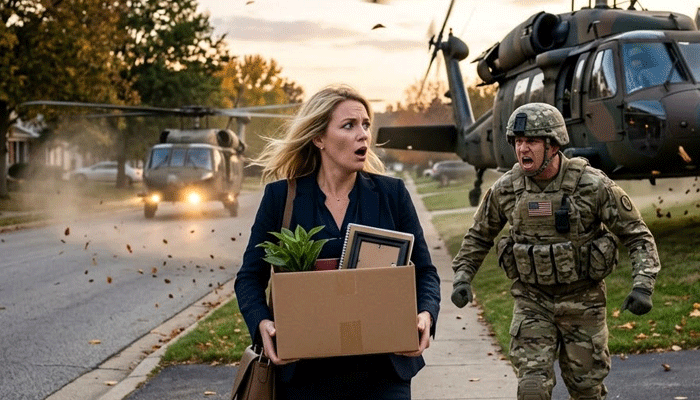
30 minutes ago, Grana Jenkins was a nobody. She was standing in the rain holding a cardboard box filled with dried out pens and a photo of her dog, watching her 13-year nursing career wash away in the gutter. She had just been fired for saving a life the wrong way. She was broke, broken, and walking home. But she didn’t know that three miles above her, air traffic control was being overridden.
She didn’t know that two blacked out Sikorski helicopters were currently screaming toward the highway with one directive, “Find the nurse.” When the world kicks you to the curb, sometimes destiny lands on the pavement right in front of you, armed with assault rifles and a screaming billionaire. The fluorescent lights of the human resources office at St.
Jude’s Medical Center in Seattle hummed with a headacheinducing frequency that Grana Jenkins knew intimately. It was the sound of bureaucracy. It was the sound of a hospital that had stopped being a place of healing and had started being a corporation of liability management. Grana sat in the stiff gray chair, her hands folded tightly in her lap to stop them from shaking.
She was 34, but in that moment, staring across the mahogany desk at director Patricia Gills, she felt about 12. Insubordination, Patricia said. She didn’t say it with anger. She said it with the casual indifference of someone ordering a sandwich. She tapped a manicured fingernail against the thick file folder on her desk.
Gross negligence of hospital protocol. unauthorized administration of a schedule two narcotic without an attending physician’s direct sign off and let’s not forget hostile attitude toward senior management. Grana took a breath. It felt like inhaling broken glass. The patient was seizing Patricia. It was status epilepticus. Dr.
Halloway wasn’t answering his pager. He was on a golf break. I know because his resident told me Dr. Halloway, Patricia corrected sharply, her eyes narrowing behind her rimless glasses, was in a strategic meeting with the board of donors, and that is irrelevant. The protocol states you stabilize and wait. You do not push 4 mg of laorazzipam on your own authority.
He would have died, Grana said, her voice rising just an octave. His oxygen sats were in the 60s. He was turning blue. If I had waited the 10 minutes for Halloway to finish his meeting, that 20-year-old kid would be brain dead right now. Patricia sighed, opening the file and sliding a single piece of paper across the desk. It was already signed.
But he isn’t brain dead, is he? He is alive, and his family is suing us because he aspirated during the seizure. They claim if a doctor had been present, the intubation would have happened sooner. Grana felt the blood drain from her face. That’s insane. I saved him. You created a liability, Patricia said, capping her pen. St.
Jude’s cannot afford liabilities. We are in the middle of a merger with the Unicare group. We need clean sheets, Grana. And you? You’re a stain. The word hung in the air, heavy and gross, a stain. Grana thought about the double shifts she pulled during the flu outbreak of 2018. She thought about the Christmas Eve she spent holding the hands of dying grandmothers so they wouldn’t be alone.
She thought of the back injury she nursed for 3 years because she lifted a heavy patient off the floor when the orderlys were on strike. I want to speak to the chief of medicine,” Grana whispered. Dr. Halloway is the acting chief of medicine. Patricia smiled, a cold, tight expression that didn’t reach her eyes.
He signed your termination letter himself. Effective immediately, security is waiting outside to escort you to your locker.” Grana stood up. Her legs felt like lead. She wanted to scream. She wanted to flip the mahogany desk and shatter the window overlooking the rainy city, but she was a nurse. She was trained to keep calm when the walls were caving in.
“You’re making a mistake,” Grana said, her voice trembling only slightly, “Not just for me, but for the next patient who comes in dying when Halloway is busy schmoozing donors.” Patricia didn’t even look up. Please leave your badge on the desk, Miss Jenkins. The walk to the locker room was a blur.
The hallway, usually a place of adrenaline and purpose, felt like a long white tunnel. She saw colleagues she had known for a decade. Greg from radiology, Susan, the head of pediatrics. They looked away. They knew. The hospital grapevine moved faster than a viral infection. In their eyes, she saw pity, but mostly she saw fear.
Don’t look at her or you might be next. She packed her locker. It didn’t take long. A stethoscope she bought with her first paycheck, a spare pair of scrubs, a bottle of ibuprofen, and a framed photo of her golden retriever, Buster, who had passed away last year. The security guard, a man named Miller, who she had shared coffee with a hundred times, refused to make eye contact as he walked her to the automatic sliding doors.
Sorry, Grana, Miller mumbled as the doors hissed open. It’s okay, Miller, she said softly. Just don’t get sick here. She stepped out. Seattle was living up to its reputation. The rain wasn’t just falling. It was attacking the pavement. It was a cold, gray deluge that soaked through her thin scrub top in seconds.
Grutched her cardboard box to her chest, trying to shield the contents. She reached into her pocket for her car keys. And then she remembered the transmission on her 2014 Honda Civic had died 2 days ago. She had left it at the mechanic’s shop on 4th Avenue. The estimate was $2,400. She checked her bank account on her phone as the rain plastered her hair to her face. Checking $412.38.
Savings $50. She couldn’t afford the repair. She couldn’t even afford an Uber to get home, which was 6 mi away in the cheaper district of Burian. She looked at the bus schedule. The next 132 bus wasn’t due for 40 minutes. Grana Jenkins, the woman who could insert an IV into a collapsing vein in a moving ambulance, the woman who could calculate drug dosages in her head while performing CPR, let out a sob that was instantly swallowed by the sound of traffic.
She turned up her collar, hugged her box, and started walking. The walk was grueling. The rain was relentless, mixing with the spray kicked up by passing semi-truckss to create a miserable, gritty mist. Grana walked along the shoulder of the highway, the gravel crunching beneath her worn out sneakers. Mile one was anger. She replayed the conversation with Patricia Gills over and over, coming up with the perfect comebacks she hadn’t used.
Mile two was fear. How would she pay rent? Her nursing license might be flagged. If Halloway put gross negligence on her record, she wouldn’t be able to get a job at a school nurse’s office, let alone another ER. She was 34, single, and career dead. By mile three, she was just numb. She was soaked to the bone, shivering violently.
Her box was soden, the cardboard disintegrating in her hands. She was crossing the pedestrian overpass that spanned the I5 freeway, a concrete bridge caged in chainlink fencing. Below her, the evening rush hour traffic was a river of red tail lights and white headlights indifferent to her existence. That was when she heard it.
It started as a thumping in her chest, a rhythmic low frequency vibration that rattled the chainlink fence against her fingers. Thump, thump, thump. Grana stopped, wiping water from her eyes. She looked up. The low clouds were glowing with the reflection of the city lights, but something was cutting through them. The sound grew louder, shifting from a vibration to a roar.
It wasn’t the high-pitched whine of the news choppers or the steady drone of the medical airlift. This was heavy. This was aggressive. Two shapes tore out of the cloud layer about half a mile north. They were black, sleek, and terrifyingly fast. They were military-grade birds, looking like predators, hunting prey. They banked hard, disregarding all civil aviation altitudes swooping low over the highway traffic.
Cars below began to break, the red river of lights bunching up as drivers slowed to gawk. “What in the world?” Grana whispered, her teeth chattering. The helicopters didn’t continue towards the airport. Instead, they slowed, hovering aggressively over the highway, their search lights snapping on. The beams cut through the rain like solid bars of light, sweeping the road, sweeping the embankment.
They were looking for something or someone. Gran watched, mesmerized. It felt like watching a movie scene. The lead helicopter, a massive beast with no markings other than a silver insignia she couldn’t make out, pivoted. The nose dropped and it began to descend. “Where is it landing?” Gr. There’s nowhere to land. But the pilot didn’t care.
The chopper flared, the rotor wash hitting the overpass with the force of a hurricane. Grana had to drop to her knees, clutching the chainlink fence to stop from being blown over. Her cardboard box went flying. her pens and the photo of Buster scattering into the dark, wet void below. “No!” she screamed, but the sound was lost in the turbine scream.
The helicopter hovered 10 ft above the wide grassy embankment right next to the overpass exit. It didn’t even touch the ground. The side door slid open. Three men jumped out. They didn’t look like police. They looked like soldiers from a futuristic nightmare. They wore tactical black gear, rains vests and headsets.
They carried rifles, but they were slung across their chests, not raised. They moved with terrifying precision. The second helicopter circled above, its spotlight fixed directly on the overpass, directly on Grana. She froze. The light was blinding. She held up a hand to shield her eyes. her heart hammering against her ribs like a trapped bird. “Run!” her brain screamed.
“Run, you idiot!” But she couldn’t move. One of the men on the ground looked up at the bridge. He tapped his headset and pointed directly at her. He didn’t shout. He just started sprinting up the concrete stairs of the overpass, taking them three at a time. Grana scrambled backward, her back hitting the wet concrete railing.
“Stay away!” she yelled, though she knew they couldn’t hear her. The man reached the top of the stairs in seconds. He was huge, easily 6’4, with a scar running through his left eyebrow and rain dripping from his tactical beard. He stopped 5 ft from her, raising his hands in a stop motion. Grana Jenkins, he roared over the noise of the rotors.
His voice was gravel and authority. Grana nodded, too terrified to speak. She pressed herself harder against the railing. The man tapped his earpiece. Target acquired. Repeat. Nurse is secure. We are green for extraction. He stepped closer. Grana flinched. Ma’am, you need to come with us now. Who are you? She screamed. Am I under arrest? I didn’t kill that patient.
He lived. The man looked confused for a split second, then shook his head. We aren’t the police, Mom. We don’t have time. You are the only one listed in the registry with the specific specialization we need who is currently offrid and available. I’m not available. I’m walking home. Not anymore, the man said. He reached out, grabbing her arm.
His grip was iron, but not hurtful. We have a critical medical situation. A code black. We have been tracking your phone for the last 20 minutes. My phone? Grana gasped. We saw you leave the hospital. We know you were terminated. That makes you a free agent. He pulled her toward the stairs.
And right now, my employer is offering $500,000 for one night of your time. But we have to go now. Grana stopped resisting. The number hit her brain and shortcircuited her fear. Five? What? Half a million. Tax-free. If he lives, if who lives? The man didn’t answer. He practically carried her down the stairs towards the waiting helicopter.
The rotor wash was deafening, flattening the grass and whipping Grana’s wet hair across her face. As she was shoved into the back of the dark cabin, she saw another figure inside. A woman in a sharp business suit, typing furiously on a tablet, looking completely out of place in a war machine. The soldier jumped in beside Grana and slammed the sliding door shut.
The noise dampened instantly, replaced by the high-pitched whine of the engines. “Go, go, go!” the soldier yelled into his headset. The helicopter lurched upward, leaving Grana’s stomach on the ground. She looked out the window and saw the overpass shrinking below them. She saw her scattered pens on the wet concrete.
“Put this on,” the woman in the suit said, not looking up, handing Grana a headset. Grana put it on. Miss Jenkins, the woman said, her voice crystal clear through the noiseancelling headphones. My name is Isabelle Vance. I work for the Concincaid family office. You are currently the highest paid unemployed nurse in American history.
Do not ask where we are going. Do not ask who the patient is until we arrive. Your job is to keep him breathing. Do you understand? Grana looked at her wet scrubs, her shaking hands, and the city lights blurring below. I I understand, Grana stammered. But I don’t have my equipment. I don’t have anything. Isabelle Vance finally looked up.
Her eyes were terrified. We have the equipment, Miss Jenkins. What we don’t have is time. The helicopter cut through the storm like a knife. Inside the cabin, the vibration was intense, rattling Gran’s teeth, but the noiseancelling headset created an eerie, muffled silence where only voices existed.
Grana gripped the safety handle above the door, her knuckles white. She looked across the cabin at the woman, Isabelle Grant. Grana had misheard her name as Vance earlier over the wind, but the ID badge swinging from her lanyard clearly read, “Grant Isabel, chief of staff.” Isabelle was handing her a tablet. Sign this, Isabelle said, her voice flat.
Thumbr print on the bottom right. What is it? Grana asked, her voice sounding tiny in her own ears. Non-disclosure agreement. Standard procedure for anyone entering the Concincaid estate. Penalty for breach is $20 million and federal imprisonment for corporate espionage. Grana stared at the screen. The text was scrolling too fast to read, a blur of legal ease. I don’t have $20 million.
I have $400 and a broken Honda. “Then don’t breach it,” Isabelle said, her eyes never leaving her own phone. “We are 7 minutes out.” The soldier, the one with the scar who had pulled her from the bridge, sat opposite Grana. He had removed his helmet. His face was hard, carved from granite, but his eyes, steely blue, were watching her with a strange intensity. He extended a hand.
“Sergeant Major Silas,” he said. ex- ranger, currently head of security for Mr. Concincaid. Sorry about the box. My dog’s picture was in there, Grana said. A sudden wave of grief hitting her. It seemed like such a stupid thing to care about when she was being kidnapped by billionaires. But it was the only thing that felt real.
Silas paused, his expression softening just a fraction. I’ll have a team sweep the embankment. If they find it, we’ll get it to you. I promise. Why me? Grana asked, ignoring the promise. She looked between Silas and Isabelle. You said specific specialization. I’m an ER nurse. There are thousands of us in Seattle. Better ones.
Ones who haven’t just been fired for insubordination. Isabelle stopped typing. She looked up and for the first time Grana saw the desperation cracking through her professional veneer. We don’t need a doctor who follows orders, Miss Jenkins. Isabelle said quietly. We have three of the best doctors in the world at the estate right now.
They are following the protocols. They are following the textbook and Elias Conincaid is dying. EliasQincaid. Grana gasped. Even she knew the name.Qincaid Conincaid was tech royalty. He had built the infrastructure half the internet ran on. He was worth billions. He was also a recluse who hadn’t been seen in public for 5 years.
He has a condition. Silas interjected. It’s complicated. But the medical team is paralyzed. They are terrified of killing the golden goose. So they are being conservative. Too conservative. We monitored your incident today at St. Jude s. Grana felt a chill that had nothing to do with her wet clothes. You were watching me.
We watch everyone in the medical field within a 50-mi radius of the estate. Silus said matterofactly. We have algorithms that flag certain keywords in hospital administrative logs. Insubordination for life-saving measures popped up. You saved a kid by breaking the rules. You acted when the doctor wouldn’t. That’s why you’re here, Isabelle added.
Mr.Qincaid doesn’t need a yes man. He needs someone who will actually look at the patient, not the liability insurance. The helicopter banked hard to the left. Grana looked out the window. The lights of Seattle were gone. Below them was the dark, churning water of the Puget Sound. Ahead, a small private island emerged from the gloom, lit up like a fortress.
A massive modern mansion sat on the cliff edge, all glass and concrete. A helipad canvered over the ocean was illuminated by blue perimeter lights. “We’re landing hot,” the pilot’s voice crackled over the intercom. “Medical team is on the pad. Vitals are crashing. O2 is down to 82%.” “82?” Grana’s nurse brain snapped into gear, overriding the surreal nature of the situation.
Is he intubated? No, Isabelle said. Dr. Hazel refuses to intubate. He says the risk of triggering a lingial spasm is too high given the complications. If he’s at 82 and dropping, he doesn’t have a choice, Grana said, unbuckling her harness before the wheels even touch down. Who is Dr. Hazel? Conrad Hazel, Isabelle said, chief of concage medicine at John Hopkins before we hired him.
Grana groaned. She knew the type. Academic, brilliant, and utterly useless in a street fight. The helicopter slammed onto the pad, the suspension groaning. The door slid open, and the rain whipped in again, but this time it smelled of sea salt and ozone. Silas jumped out first. Move. Move. Grana followed him, running toward the group of people waiting by the glass doors.
She was still wearing her soaked scrubs, her hair a disastrous mat against her skull, shivering in the wind. She looked like a drowned rat. But as she crossed the tarmac, something shifted. She wasn’t the fired employee anymore. She was the one they had sent a helicopter for. She ran into the house, leaving her old life on the wet pavement behind her.
The interior of the Concincaid estate was more like a spaceship than a home. White marble floors, floor to-seeiling windows that looked out into the black storm, and art that probably cost more than the hospital wing she used to work in. But Grana didn’t look at the Picasso on the wall.
She followed the noise down a long corridor past terrified looking house staff into a room that had been converted into a fullscale intensive care unit. The equipment was state-of-the-art ventilators, dialysis machines, monitors that Grana had only seen in medical journals. In the center of the room, on a bed that looked more like a throne, lay Eliasqincaid.
He was older than his photos, frail, his skin a terrifying shade of gray blue. He was gasping for air, his chest heaving with the effort. Three people in scrubs were hovering around him. The tallest one, a silver-haired man with pristine glasses, was arguing with a younger doctor.
I said, “No paralytics,” the silver-haired man shouted. “His nervous system is already compromised. If we paralyze him for intubation, we might never get him back. He’s hypoxic, Dr. Hazel,” the younger one argued. He’s drowning in air. Push more EPI. Hazel barked. Stop. Oh. [groaning] Gran yelled. The room froze. The beep of the heart monitor, which was racing at 140 beats per minute, was the only sound. Dr.
Hazel turned, looking gran up and down with a look of pure revulsion. Who the hell is this? Why is there a wet vagrant in my ICU? Isabelle stepped in behind Grana. This is Nurse Jenkins. I brought her. Get her out. Hazel snapped. This is a sterile environment. She’s dripping rainwater on my floor. Grana ignored him.
She walked straight to the bedside. She looked at Elias Concincaid. His eyes were open wide with panic. He was conscious. He was drowning and he knew it. She looked at the monitor. Paper P2 78% BP 18110. She looked at his neck. The veins were distended, bulging like ropes. She looked at his hands. The nail beds were blue.
“He’s not just hypoxic,” Grana said, her voice calm, but loud. “He’s intention pneumothorax. Look at his trachea,” Hazel scoffed. “Don’t be ridiculous. He hasn’t suffered any trauma. He’s suffering from a neurodeenerative cascade. Look at his trachea, Grania screamed, pointing. The deviation was slight, but it was there. His windpipe was shifted to the left.
He has a spontaneous pneumo thorax, Grana said rapidly. His lung collapsed, probably a bleb rupture from the stress of whatever treatment you’re giving him. The air is building up in his chest cavity, crushing his heart and his other lung. If you don’t decompress it right now, he goes into cardiac arrest in less than 2 minutes. Hazel hesitated.
He looked at the monitor, then at Grana, then back at the patient. That’s a theoretical impossibility given his give me a 14 gauge angioath, Grana ordered, extending her hand to the younger doctor. Do not give her anything, Hazel roared. Security, remove her. Silas stepped into the room. He was soaking wet, holding his rifle.
He looked at Hazel. Then he looked at Grana. “Are you sure?” Silas asked Grana. “Oh, look at the pressure.” Grana pointed to the blood pressure monitor. “It’s climbing because his heart is being squeezed. He’s going to code. I need a needle now.” Silus turned his weapon, not aiming it, but shifting it significantly towards the supply cart.
He looked at the young doctor. Give her the needle. This is assault. Hazel screamed. I will have your badge, Silus. I will have all of you arrested. The young doctor, hands shaking, ripped open a package and handed Grana the large bore needle. Grana didn’t hesitate. She ripped the expensive silk pajama shirt open, exposing Elias’s chest.
She felt for the second intercostal space mid-clavicular line on the right side. Miss Jenkins, if you are wrong,” Isabelle said from the doorway, her voice trembling. “You are stabbing a billionaire in the chest.” “He’s already dead if I don’t,” Grana muttered. She swabbed the spot with an alcohol wipe. She grabbed from the tray.
“Don’t you dare,” Hazel lunged forward. Silas stepped in his path, a solid wall of muscle. Grana looked into Elias Conincaid’s terrified eyes. “I’m sorry. This is going to hurt,” she whispered. She plunged the needle in. There was a distinct pop as it pierced the plura and then a sound that everyone in the room heard, a sharp hiss like a tire deflating.
The air rushed out of the chest cavity. Elias Conincaid gasped, a huge, deep, ragged breath. The monitor began to sing a different tune. SPO2 80% 85% 90% heart rate 140 120 100 The color began to flood back into his gray cheeks. The panic in his eyes receded, replaced by exhaustion and relief. Grana taped the catheter in place, her hands finally shaking now that the moment was over.
She stepped back, exhaling a breath she felt like she’d been holding since she got fired. The room was silent. Dr. Hazel stood frozen, staring at the needle sticking out of his patient’s chest. The evidence of his incompetence was vibrating right there in front of him. Elas Conincaid turned his head slowly on the pillow.
He looked weak, but his mind was clearly coming back online. He looked at Hazel, then he looked at Grana. He pulled the oxygen mask down slightly. Who? His voice was a rasp, barely a whisper. Who is she? Isabelle stepped forward, looking from the monitor to Grana with a mixture of shock and awe. That is Grana Jenkins, sir, the nurse we found.
Elias nodded slowly. He closed his eyes. Fire, Hazel, he wheezed. Sir, Hazel choked out. The Numthorax was an anomaly, a statistical outlier. You can’t get him out of my house, Elias whispered. And get her a dry set of scrubs. Silus grabbed Dr. Hazel by the arm. Time to go, Doc. As Hazel was dragged out, shouting threats about lawyers and medical boards, Grana leaned against the expensive medical cart. Her knees felt like jelly.
Isabelle walked over to her. She looked at Grana’s dirty sneakers, her wet hair, and the fierce determination that was still burning in her eyes. “Okay,” Isabelle said, her voice steady now. You just earned your first night’s pay, but don’t get comfortable. Why? Grana asked, wiping rain water from her forehead.
Isabelle gestured to the monitors that lined the wall. Not medical monitors, but security feeds. They showed the perimeter of the island. Because the numoththorax wasn’t an accident, Isabelle said, dropping her voice so the other staff couldn’t hear. Elias has been in this room for 3 months. He hasn’t moved.
A lung doesn’t just pop on its own when you’re bedbound unless someone increased the ventilator pressure remotely. Grana froze. You think someone tried to kill him tonight? I think, Isabelle said, looking at the door where Hazel had just exited, that you just ruined someone’s very expensive assassination plan.
And now you’re the only thing standing between Elias and the next attempt. Grana looked at the frail old man in the bed. He wasn’t just a patient anymore. He was a target and she was the shield. “I need coffee,” Grana said. “And I need access to his full chart, the real one, not the one Hazel was using.” Isabelle nodded.
“Welcome to the Concincaid team, Grana. Try to stay alive.” The adrenaline crash was brutal, but Grana didn’t have time for it. Two hours had passed since she had shoved a needle into the chest of the 53rd richest man in the world. The room was now quiet, save for the rhythmic whoosh click of the ventilator, which Grana had readjusted to a safe peep setting, and the steady beep of the cardiac monitor.
Grana was no longer wet. She was wearing a pair of navy blue scrubs she had found in the supply closet, scrubs that were clearly meant for a man three sizes larger than her. She had rolled up the sleeves and tied the drawstring tight. She sat at the foot of Elias Conincaid’s bed, surrounded by three weeks of medical chart she had pulled from the server.
Isabelle Grant was pacing the room, a phone pressed to her ear, speaking in hushed, furious tones to what Grana assumed was the company’s legal team. Silas was standing by the door, his rifle now slung across his chest, staring at the monitors with the intensity of a hawk watching a field for mice. “It doesn’t make sense,” Grana mumbled, rubbing her temples.
Silas turned his head. “What doesn’t?” “The timeline,” Grana said, pointing a pen at the tablet screen. “Dr. Hazel’s notes say that Mr. Concincaid’s decline started 6 weeks ago. It began with fatigue, then muscle weakness, then respiratory distress. The diagnosis was ALS, amotrophic lateral sclerosis, fast onset. That’s what the specialists said, Isabelle said, ending her call and walking over.
Three independent neurologists confirmed it. ALS is a motor neuron disease, Grana said, standing up and walking to the IV pole. It kills the nerves that control movement. It doesn’t cause this. She pointed to the urine collection bag hanging off the side of the bed. It’s dark. Silus noted. It’s teacolled. Grania corrected. That’s myogglobin.
It means his muscles aren’t just atrophying from nerve death. They are dissolving. Rabdomiolysis. She turned back to the chart. And look at his potassium levels. They swing wildly every night between 2:00 a.m. and 4:00 a.m. “Hazel said that was metabolic instability,” Isabelle said, her voice wavering.
“Metabolic instability doesn’t keep a schedule,” Grana snapped. She walked over to the bank of infusion pumps, the towers of technology delivering drugs directly into Elias’s veins. “There were four bags hanging. saline, propol, seditive, norepinephrine, blood pressure support, and a small black bag labeled protocol X19.
What is this? Grana asked, touching the black bag. That’s the experimental treatment, Isabelle explained. It’s a proprietary neuro regenerative compound developed by Concincaid Pharmaceuticals. It’s the only thing keeping the ALS at bay. Hazel insisted on it. Grana frowned. She traced the line from the bag to the pump.
The pump was locked with a digital passcode. Unlock it, Grana ordered. I don’t have the code, Isabelle said. Only Hazel did. Silus, Gr said, not looking away from the pump. Break it. Silas didn’t hesitate. He pulled a multi-tool from his vest, jammed it into the plastic casing of the pump, and twisted. The plastic shattered.
He pried the face plate off, exposing the manual override. Grana stopped the infusion. She disconnected the line. “Gr, if that’s the medicine keeping him alive,” Isabelle started. “It’s not medicine,” Grana said, holding the tubing up to the light. The liquid inside was clear but slightly viscous. “I’ve seen this viscosity before in the ER when we get overdose cases from the docks.
” She grabbed a syringe, drew 5cc of the liquid from the bag, and walked over to the small bedside lab analyzer, a million dollar piece of equipment that could run blood panels in seconds. She squirted the liquid onto a test slide, and shoved it in. “Run a toxicology screen,” she commanded the machine. “Full spectrum.
Look for heavy metals and organo phosphates.” The machine word, “You think he’s being poisoned?” Silus stepped closer, his hand tightening on his weapon. “I think ALS is a convenient diagnosis because it’s incurable and fatal,” Grana said, her eyes glued to the small screen. “If a billionaire dies of ALS, it’s a tragedy. If he dies of poison, it’s a murder investigation.
” The machine beeped. A list of compounds scrolled across the screen. Grana gasped. “What is it?” Isabelle asked. Sinylcholine, Gran whispered. And trace amounts of thallium. English, Silas demanded. Cicinylcholine is a paralytic, Grania said, her voice shaking with rage. We use it for intubation to stop patients from moving, but it wears off in minutes.
Unless Unless you drip it constantly at a micro dose. She turned to look at the sleeping form of Elias Conincaid. He doesn’t have ALS, she said, horror dawning on her. He’s just paralyzed, chemically paralyzed. He’s been awake inside his own body for 6 weeks, unable to move, unable to speak, unable to breathe on his own. Well, Hazel pumped him full of this this nightmare.
And the thallium? Isabelle asked, looking sick. Thalium is a heavy metal. It causes hair loss, nerve pain, and muscle weakness. It mimics the symptoms of ALS perfectly. If you don’t look too closely at the blood work, it’s the perfect cover. Grpped the black bag off the pole and threw it into the biohazard bin. He’s not dying of a disease, Grana declared.
He’s being murdered by his own medicine. Suddenly, the heart monitor spiked. Beep beep beep beep. Grun. Elias’s eyes were open. But they weren’t just open. They were focused. He was looking right at her. The paralytic was short acting. Since she had pulled the line 5 minutes ago, it was already clearing his system.
He tried to speak, but the ventilator tube was still in his throat. He gagged, his hands twitching feebly against the sheets. It’s okay. It’s okay. Grushed to his side, grabbing his hand. Mr. Concincaid, listen to me. I’m Gran. I know what they did to you. I stopped the drug. You’re going to get your strength back, but right now you have a tube in your throat helping you breathe. Don’t fight it.
Elias squeezed her hand. It was weak, barely a flutter. But it was there. He blinked twice. He can hear us, Grana said, looking at Isabelle. He’s in there. Who would do this? Isabelle whispered, tears streaming down her face. Hazel was just a doctor. He didn’t have a motive. “Hazel was the weapon,” Silas growled, his face darkening.
“The hand that held the knife. But someone else paid for the knife.” Silus tapped his earpiece. Control, this is Silus. Lock down the facility. Code red. No one in or out. I want a full sweep of the perimeter. We have a confirmed assassination attempt on the principal. Copy that, boss. A voice crackled in his ear. Perimeter is secure, but we have a problem.
What problem? The storm, boss. It’s messing with the sensors. We’re getting ghost signals on the thermal cameras, and the mainland ferry terminal just called. They said a maintenance crew was dispatched to the island for a power grid check. Silus went rigid. We didn’t order a power grid check. Exactly, the voice said, and the ferry left 20 minutes ago. It’s landing in five.
Silas looked at Grana. Can he be moved? Gr looked at the ventilator, the dialysis machine, the complex web of lines keeping Elias stable. Moving him right now could kill him. His lungs are still recovering from the numthorax. He needs stability. Well, Silas racked the charging handle of his rifle, the metallic clack clack echoing in the sterile room. Then we hold the fort.
Grana, keep him alive. Isabelle, get in the safe room. I’m going to the dock to meet the maintenance crew. Silus, Grana said. He stopped at the door. Be careful. He gave her a grim, tight smile. Careful is for nurses. I’m security. He vanished into the hallway. The storm outside had escalated from a gale to a full-blown tempest.
The wind howled against the reinforced glass of the mansion, sounding like wolves trying to claw their way in. Grana was alone in the medical suite with Elias. Isabelle had refused the safe room, opting instead to monitor the security feeds from the ops center in the basement. Grana was busy.
She was flushing Elias’s system with fluids, trying to dilute the thallium and clear the paralytic. I’m going to take the tube out soon, she told him softly, checking his oxygen saturation. It was holding at 96%. You’re doing great. Just breathe with the machine. Elias blinked again. His eyes followed her everywhere.
There was intelligence there and a profound, terrifying gratitude. Suddenly, the lights flickered. Grana froze. The hum of the ventilator didn’t waver. It was on battery backup. But the overhead lights died, plunging the room into darkness for a second before the emergency red mood lighting kicked in. Crack.
A sound echoed from somewhere deep in the house. It sounded like thunder, but Grana knew better. She had grown up in a rough neighborhood. She knew the sound of a gunshot. Isabelle. Grana tapped the comm’s unit Isabelle had given her. Static. Isabelle, talk to me. Nothing. Gr’s heart began to hammer against her ribs. She looked at Elias.
His eyes were wide with panic. The monitor showed his heart rate climbing. 110. 120. Stay calm,” she whispered, though she was terrified herself. “High heart rate increases oxygen demand. You need to stay calm.” She ran to the door and locked it. It was a heavy hospital-grade door, but it wouldn’t stop a bullet. She dragged the heavy supply cart in front of it. Another gunshot.
Closer this time, then the distinct rattle of automatic fire. Silus. She looked around the room. It was a medical suite, not an armory. She had scalpels, needles, drugs. Think, Grana. Think. She grabbed a bag of salin and a roll of medical tape. She grabbed a handful of vials from the crash cart. Epinephrine, atropene, potassium chloride.
Potassium chloride, KCL. In a controlled dose, it replaced electrolytes. In a high dose, pushed rapidly. It stopped the heart instantly. It was what they used for lethal injections. She drew up three large syringes of KCL. She moved to the side of the door, pressing her back against the wall, holding a syringe like a dagger.
The gunfire stopped. The silence that followed was worse. It was heavy, suffocating. Steps in the hallway. Heavy boots. Wet boots. Squeak. Squeak. Squeak. Grana held her breath. The handle of the medical suite door jiggled. Then a heavy thud as someone threw their shoulder against it. The supply cart rattled but held.
“Open the door, nurse!” a voice called out. “It wasn’t Silas. It was smooth, accented, and calm. We know you’re in there. Dr. Hazel told us about the new girl.” Grana didn’t answer. She looked at Elias. He was staring at the window. Grana followed his gaze. The window? The massive floor to-seeiling glass panel that overlooked the cliffs.
A figure in black absailing gear swung into view, smashing through the glass with a breach hammer. Smash! Wind and rain exploded into the room, sending papers flying. The intruder swung in, landing in a crouch amidst the shattered glass. He was dressed in tactical black, wearing a balaclava. He raised a suppressed pistol. Grana didn’t think. She reacted.
She threw the heavy saline bag at him with all her strength. It wasn’t a lethal weapon, but it was a distraction. The gunman flinched, batting the bag away. That split second was all Grana needed. She lunged. She wasn’t a fighter. She didn’t know karate. But she knew anatomy. She knew exactly where the jugular vein was.
She knew where the corroted artery sat. She jammed the syringe toward his neck. The gunman was fast. He caught her wrist. His grip was like a vice. He twisted her arm and Grana screamed as she felt the tendon strain. He backhanded her, sending her flying across the room. She crashed into the diialysis machine, the syringe skittering across the floor.
Feisty, the gunman said, stepping over the glass. He didn’t look at her. He looked at Elias concaid contract closed. He raised the gun towards the bed. No. Grana scrambled up, grabbing a scalpel from the tray on the floor. The door behind the barricade exploded. Not opened. Exploded. A breaching charge blew the hinges off.
The heavy door and the supply cart were blasted inward, knocking the gunman off balance. Silas walked through the smoke. He looked like a demon. His tactical vest was shredded. He was bleeding from a wound in his shoulder, but his rifle was up. Thump, thump. Two suppressed shots. The gunman by the window dropped.
two holes in his chest before he even hit the ground. Silus scanned the room. “Clear,” he yelled, though there was no one else there. He looked at Grana. She was huddled by the diialysis machine, bleeding from a cut on her lip, holding a scalpel. “You okay?” he grunted, wincing as he touched his shoulder.
“I I think so,” Grana stammered. She looked at the dead man on the floor. “Is it over?” The team at the dock is neutralized, Silas said, kicking the gunman’s pistol away. This one was the flanker. They tried to pinch us. He walked over to Elias. Mister Conincaid status. Elias blinked rapidly. He was alive.
Suddenly, the power flickered and returned. The main lights hummed back to life. Silus. Isabelle’s voice came over the wall intercom, frantic. Silus, are you there? the servers. Someone is accessing the main frame directly from the medical suite. Silas and Grana both froze. There’s no one here but us, Silus said. No, Grana said, her eyes widening.
She looked at the dead gunman. He wasn’t wearing a headset. He was wearing a backpack with a transmitter. And he was holding a device in his left hand, even in death, a data spike. He wasn’t just here to kill him, Grana realized. She ran to the body. The gunman had jammed a drive into the port on the back of the advanced medical ventilator, the one connected to the hospital network.
He was uploading something or downloading, Silus said. The algorithm, a rasping voice said. They both spun around. Eliasqincaid had pulled the tube out of his own throat. He was coughing, sputtering blood, his throat raw. It was a dangerous, stupid move, but he had done it. Mr. Concincaid Grana rushed to him, grabbing an oxygen mask.
He pushed the mask away, his voice a broken gravel sound. They didn’t come to kill me. Not yet. They came for the encryption key. He pointed a shaking finger at the dead man’s device. It’s in my biodata. The key is my heartbeat. Grana looked at the monitor. The gunman’s device was syncing with the cardiac rhythm monitor.
It was recording the precise chaotic fluctuations of IAS’s heart rate variability. It’s a biometric lock, Silus realized. The most secure in the world. Only his live heartbeat can unlock the concaid quantum server. If they get it, Elias wheezed, grabbing Grana’s scrub top, pulling her close. His eyes were desperate.
If they get the code, they can crash the global banking system. They can turn off the power grids, everything. Grana looked at the data spike. The progress bar on the small screen read 98%. Silus, shoot it, Grana yelled. If I shoot it, it might upload the packet instantly on failafe. Silus yelled back. Disconnect him. Elias rasped.
Stop my heart. Grana froze. What? Stop my heart, Elias screamed, a wet, gurgling sound. It’s the only way to break the sink. Kill me, then bring me back. I can’t, Grana cried. You’re too weak. You won’t come back. Do it, Silus roared. Look at the screen. 99%. Grana looked at the syringe of potassium chloride still lying on the floor where she had dropped it. It was madness.
It was against every oath she had ever taken. But she looked at the dead mercenary. She looked at the terrifying tech connecting the dying billionaire to a device that could destroy the world. She grabbed the syringe. She scrambled to the IV port. I’m sorry, she sobbed. Do it. Elias whispered, closing his eyes. Grana pushed the plunger.
The monitor wailed a solid flat tone. Beep. The line went flat on the gunman’s device. The screen flashed red. Sync failed. Biometric mismatch. Upload aborted. The device sparked and went dark. Silence. He’s flatlined. Silus said, his voice hollow. Grana didn’t wait. She didn’t think. She dropped the syringe and climbed onto the bed, straddling the chest of the man she had just killed. Not today, she growled.
Not on my shift. She interlaced her fingers. She locked her elbows and she began to compress the chest. Crack. A rib broke. She didn’t care. Come on, she screamed, pumping hard, finding the rhythm. Come on, you stubborn billionaire. Come back. Silus watched helpless as the fired nurse from Seattle fought God for the soul of Elias Conincaid.
Grana’s hands were burning. Each compression drove pain up her arms and into her shoulders, but she didn’t slow. “A 1, two, three, Silus, epinephrine, now!” Silas fumbled with the vial, his massive fingers shaking. “It’s in.” “Calcium!” Grana shouted. “Red box, second draw.” She was doing CPR on a man she had technically killed minutes earlier.
She didn’t think about that. She couldn’t. She focused on rhythm, depth, recoil, rate. Silus tossed her the syringe. She injected it without missing a beat. Stay with me, she whispered. You don’t get to quit. The monitor screamed its merciless tone. Flatline. A minute passed. Then another. He’s gone, Silus said quietly.
You did everything. I’m not done. Grana snapped. She slammed her fist onto Elias’s chest. Thump. Nothing. She resumed compressions, her vision blurring with tears and exhaustion. Please, she breathed. Please. The monitor twitched. A jagged spike appeared. Vib, Grana cried. Charge. 200 jewels. Silus spun the dial. Charging.
Clear. Thunk. Elias’s body arched, then fell. Silence. The monitor recalibrated. Beep beep beep. A weak but steady rhythm. Elias gasped, dragging air into his lungs like a drowning man breaking the surface. Grana collapsed beside the bed, sobbing. Two days later, the storm was over. Sunlight spilled across the concaid estate as Grana sat wrapped in a blanket, coffee warming her hands.
Isabelle filled her in quietly. Arrests, indictments, collapsed mergers, justice at last. Behind her, wheels rolled softly. Silus pushed Elias onto the terrace. Alive, smiling. You killed me, Elias said hoarsely, and revived you, Grana replied. He handed her something, her hospital badge, and Buster’s restored photo, her breath caught.
I’m building something new, Elias said. Emergency teams, no politics, no corruption. I want you to run it. Gran laughed weakly. Me? You saved my heart, he said. Now save others, Silus added. And your Hondas replaced, she groaned. You didn’t. I did. Grana looked at the sunrise, at her dog’s photo, at the future she never expected.
One condition, she said. Name it. We hire Miller. Elias smiled. Done. She took his hand. For the first time in months, she wasn’t surviving. She was home. Grana Jenkins didn’t just survive the worst night of her life. She rewrote her entire destiny. She went from a fired, soaking wet nurse on the side of a highway to the director of a global medical strike team.
All because she refused to let a patient die. Whether it was a seizing teenager in an ER or a billionaire in a golden cage. The investigation into the UNICAR emerger exposed one of the largest corporate espionage scandals in history. Dr. Halloway and Dr. Hazel are currently serving consecutive life sentences. Silas remains head of security, though he now spends most of his time complaining about Grana’s reckless driving in her new Range Rover.
As for Grana, she still keeps the box with the dried out pens on her mahogany desk. A reminder that sometimes when you hit rock bottom, the only way out is to look up and catch the helicopter. Wow, what a ride. If Grana’s story kept you on the edge of your seat, smash that like button right now.
It really helps the channel. And here is a question for you. If you were in Gran’s shoes, would you have injected the potassium to stop his heart or would you have risked the upload? Let me know in the comments below. Don’t forget to subscribe and hit the bell icon so you never miss a story. We have a crazy thriller coming up next week about a pilot who wakes up mid-flight with no crew.
You don’t want to miss it. Thanks for watching and stay safe out