Part 1
On the morning of my wedding, I stood in front of a full-length mirror and buttoned up my dress blues with hands that had held a rifle steadier than they held joy.
The room behind the chapel at Quantico smelled like lemon polish, old wood, and the faint powdery scent of somebody’s flowers left too long in a vase. There was a white satin dress hanging from a hook on the closet door, untouched, still zipped in plastic. My mother had sent it two weeks earlier without a note, like a correction she expected me to make. I hadn’t even taken it out of the bag.
Instead, I wore midnight blue wool, red piping, and four silver stars on my shoulders.
I ran two fingers over the top button at my throat, that little gold eagle-globe-anchor catching the light. The uniform sat on me the way truth does. Not soft. Not decorative. Exact. Earned.
Outside the thick oak doors, I could hear the low restless hum of people gathering. Shoes on stone. A laugh cut short. The old chapel organist practicing the same three notes over and over like he was nervous too. Somewhere farther off, someone called cadence as a joke and got shushed.
At the end of that aisle, Julian was waiting for me.
Julian Croft, civilian, analyst, terrible dancer, beautiful hands, the only man I had ever met who could hand me tea after a Pentagon bloodbath of a meeting and somehow make silence feel like shelter instead of emptiness. He had told me, months ago, that if I wanted to wear dress blues to our wedding, I should wear dress blues. Not because of the rank. Because they were part of my life, and he wasn’t marrying a version of me trimmed down for photographs.
He was marrying all of it.
For about ten seconds, maybe twelve, I let myself feel happy.
Then my phone buzzed on the vanity.
Saraphina.
Even her name on the screen had a way of tightening something behind my ribs. I stared at it long enough to see my own face reflected darkly in the black glass before I picked it up.
The first text came through.
Really doing this? You’re wearing the general costume to your own wedding?
Before I could breathe properly, another one landed.
Trying to prove you’re not woman enough for a dress?
And then a third.
You’ve spent your whole life playing soldier. Don’t humiliate us in front of real people.
I read that last line twice.
Real people.
It was such a Saraphina phrase. Pretty on the surface, poison under the tongue. I felt that old familiar coldness spread through me, the one I had known since childhood, the one that showed up whenever she smiled too sweetly and something precious ended up broken.
A soft knock came at the door before I could answer. It opened without waiting for permission.
Saraphina stepped inside first.
She looked exactly like the kind of woman magazines called effortless. Ivory sheath dress. Perfect blowout. Earrings that moved when she turned her head. Even her perfume was calculated—expensive white florals with something sharp underneath, like cut stems. My mother came in behind her, fussing with a clutch bag. My father followed last, already wearing the expression he reserved for boardrooms and funerals.
My sister’s eyes traveled down me slowly.
“Oh my God,” she said, and laughed once through her nose. “You actually went through with it.”
I set the phone face down on the table. “Good morning to you too.”
She took two steps closer, close enough for me to see the pale pink of her lipstick and the tiny vein pulsing at her temple. “You couldn’t just be normal for one day?”
Part 2
My mother made a soft distressed sound, like Saraphina had said something unfortunate but understandable.
“Tenna,” she said, using the voice she used on waiters when she wanted a table near the window. “Sweetheart, there’s still time. We can help you change.”
My father’s gaze stayed on the uniform. Not my face. Not my hands shaking once and then going still. The uniform.
“There are defense contractors and congressional staff out there,” he said. “People I know.”
I almost laughed. It came up bitter instead.
“Yes,” I said. “I’m aware of what my job is.”
“That’s exactly the issue.” His jaw flexed. “This is a wedding, not a command performance.”
Saraphina folded her arms. “Honestly, wearing that thing to get married feels desperate. Like you need everybody to know who you are because without it…” She tipped one shoulder. “What are you, exactly?”
The room went very quiet.
I could hear the organ stop mid-phrase outside. Somebody closed a heavy door somewhere down the hall. My own pulse thudded hard in my ears, steady and humiliating.
My mother looked at the white dress in plastic. “You would look beautiful in silk.”
I turned to her. “You don’t think I look beautiful now.”
She didn’t answer.
That hurt worse than Saraphina’s voice ever had. My sister’s cruelty was weather. Predictable. Familiar. My mother’s silence was the old wound under the scar.
Saraphina smiled, seeing the hit land.
“Wearing that uniform,” she said lightly, “is basically admitting you’re not woman enough for the dress.”
I looked at her then. Really looked.
At the satisfaction barely hidden in her eyes. At the practiced sympathy already arranging itself on my mother’s face. At my father, who still couldn’t bring himself to say, I’m proud of you, even now, even here, even with four stars on my shoulders and a lifetime of proof behind them.
Something inside me did not break.
It clicked.
A knock came again—firmer this time.
Part 3
The door opened, and Master Sergeant Diaz stepped in with Sergeant Rocco behind him, both in dress blues so immaculate they looked cut from night itself. Diaz took in the room once. His eyes flicked over my parents, paused on Saraphina, then settled on me.
“Ma’am,” he said carefully, “they’re ready.”
I frowned. “Who’s ready?”
Rocco’s mouth twitched like he was trying not to smile. “You should see it for yourself.”
Saraphina rolled her eyes. “What now, your own little fan club?”
I moved past her before I could say something I’d regret in front of God and the Marine Corps. Diaz opened the door wider. Cool air from the hallway hit my face. The narthex beyond was lined in dark wood and pale morning light, and at first all I registered was stillness.
Not the ordinary stillness of people waiting.
A held breath.
Then I stepped through the doorway and saw them.
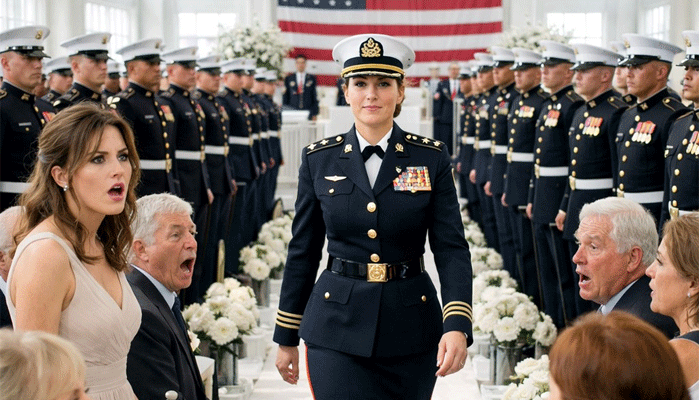
The chapel, the aisles, the side walls, the back doors, the steps beyond—every inch of it filled with Marines in dress uniform, rows and rows of midnight blue and scarlet, faces I knew and faces I didn’t, old combat scars, young nervous jaws, ribbons, medals, white gloves, polished brass. Hundreds of them.
Five hundred, as I would later learn.
All standing.
All silent.
And in that enormous, reverent hush, somebody near the front drew in breath and shouted, clear enough to shake the rafters:
“General on deck!”
Five hundred Marines snapped to attention.
And five hundred right hands rose in salute.
I had spent my whole life being told I was too much, too hard, too wrong, too unfeminine, too inconvenient. Standing there in the doorway, looking at the family waiting for me in uniform, I felt the truth hit so hard it nearly buckled my knees.
If this was what waited outside, then what exactly had my blood family been trying to keep from me all these years?