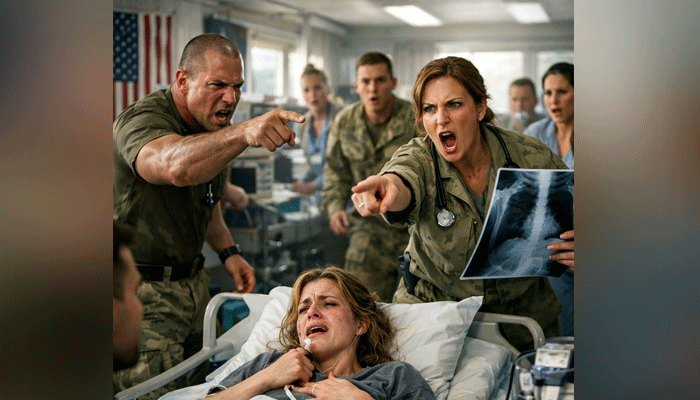
“It Was Just A Training Accident,” My Stepfather Said As I Lay Gasping For Air. “Don’t File A Report,” He Warned The Medic. But When The Army Doctor Saw The X-Rays, She Locked The Room And Said… “Call CID. PAYB Is Personal Revenge. This Was No Accident.”
The combatives room at Fort Liberty always smelled like the same three things: old sweat, rubber mats, and fear.
Not movie fear. Not dramatic fear. The ordinary kind that sits under your tongue and tastes metallic while you wait for somebody with more rank to decide what kind of day you’re going to have. The fluorescent lights buzzed overhead. The mats were gray and nicked up from boots and elbows and years of forced confidence. Around me, soldiers shifted their weight, rolled their shoulders, pretended not to be watching the man at the front of the room.
Sergeant Patrick Monroe.
My stepfather.
To the platoon, he was a tough instructor with a deployment record and the kind of flat voice that made young soldiers stand straighter. To me, he was the man who had spent sixteen years teaching me that pain could be dressed up as discipline if the right person was giving the orders.
“Garza,” he said, and the room seemed to get quieter around my last name. “Front and center.”
I stepped onto the mat because that was what soldiers did. You moved when called. You obeyed before your body had time to object.
My boots sounded too loud against the padded floor. I could feel eyes on my back. Not curious eyes. Not exactly. More like the eyes people get when they know they’re about to watch something they won’t be able to stop.
Patrick stood close enough for me to smell stale coffee under his mint gum. His face was blank in that way I knew too well. He only looked empty when he was enjoying himself.
“Today we’re demonstrating a controlled takedown,” he said to the room. “Pay attention to leverage. Technique matters more than strength.”
That line would have been funny if I hadn’t already known what was coming.
He took my right wrist. Too hard. His fingers closed over the joint like a clamp. Then he moved.
There are ways to make violence look instructional if you’re practiced enough. A twist that seems one inch too aggressive to call out. A shove with just enough force that people later describe it as momentum. He had spent years perfecting that line.
He torqued my shoulder back so suddenly that sparks shot down my arm. I gasped, tried to replant my feet, and he used that reaction exactly the way he wanted. His body turned, fast and fluid. Then his knee drove up and into my left side with full force.
Not accidental. Not glancing. Not a training bump.
Precise.
I heard the crack before I felt the worst of it.
It was a wet, ugly sound, too close to my own ear, like something inside me had snapped in private and somehow the whole room still heard it. The pain arrived half a second later—white-hot and immediate, so clean it almost felt cold. The breath left my lungs at once. The mat came up hard under my knees and then my hands.
For a second all I could see was the weave of the mat inches from my face and one dark scuff that looked like a fishhook.
Around me, nobody moved.
I was on all fours trying to remember how breathing worked when I heard PFC Evans somewhere to my right. “Sergeant, should I—”
Patrick lifted one hand without even looking at him.
“Let her get up on her own,” he said. His voice was calm, almost bored. “Pain builds character.”
That sentence hit me almost as hard as the knee.
Pain builds character.
He’d said it when I dropped a plate at twelve and he backhanded me so hard I tasted blood for an hour. He’d said it when he made me do push-ups in the gravel for talking back at fourteen. He’d said it when he ripped my spring formal dress down the front and told me embarrassment was a useful teacher.
Hearing it now, here, in front of my unit, with sergeant stripes on his chest and my ribs on fire, made something old and ugly open inside me.
Tyler, the platoon medic, had gone pale. He stood near the wall with his aid bag hanging open, one hand half-raised as if instinct had pushed him forward and fear had pulled him back.
Nobody wanted to be the first person to challenge a senior NCO in public.
Patrick knew that. He counted on it.
I tried to pull in air and got maybe half a breath before the pain seized again. My body folded tighter over itself. The room had gone dead quiet except for the lights humming overhead and my own stupid broken attempt at breathing.
Then Patrick crouched beside me, one knee on the mat, close enough that the rest of the room probably thought he was checking on me.
“Get up,” he said under his breath
I stayed where I was for one more second because my body literally could not obey.
His hand clamped down on the back of my vest and yanked me upright by force. Stars burst across my vision. I heard somebody inhale sharply in the room.
“Training dismissed,” he called out.
Boots shuffled. People moved. Nobody looked at me directly. That was worse in some ways, the way shame spreads through a room and makes decent people act like furniture.
Once the last soldier was out, Patrick dragged me toward the far corner by my good arm.
The cinderblock wall against my shoulder was cool. I remember that very clearly.
“Don’t embarrass me like that again,” he said. His voice was low, flat, intimate in the worst possible way. “You want the unit whispering that you can’t handle contact?”
I stared at a crack in the painted wall because looking at his face took more energy than I had.
He leaned closer. “Tyler will write it up as minor impact during training. You’ll back that up if anyone asks. You understand me?”
I nodded because I needed him to stop talking long enough for me to breathe.
By the time I got to Womack later, the pain had settled into something meaner. X-rays, clipped voices, cold gel under the ultrasound probe, paper gown scratching my skin. A young specialist with tired eyes said, “Looks like multiple rib fractures,” and for one bizarre second my first feeling was relief.
Broken was better than bruised.
Broken meant real.
I was in a curtained ER bay two hours later when my mother arrived carrying a glass casserole dish wrapped in a kitchen towel with yellow lemons on it.
That was the image that stayed with me more than the monitors, more than the IV taped to the back of my hand. My mother in a quilted coat, lipstick half rubbed off, holding chicken casserole like she was bringing dinner to a church potluck instead of visiting her daughter after an assault.
“Hattie,” she said softly. “Honey.”
She set the casserole in my lap because apparently she needed her hands free to beg.
Steam fogged the lid. I could smell cream of mushroom soup, black pepper, browned onions. It was the same casserole she used to make after funerals, after births, after any disaster too big to name directly. Her version of care had always come baked and cut into squares.
“Patrick said it was an accident,” she whispered. “You can’t report this. You’ll ruin his career. You’ll ruin the family.”
Her eyes met mine, and I saw it right then—no confusion, no split loyalty, no trembling maternal instinct fighting its way to the surface.
Fear.
Not for me.
For him.
My ribs hurt. My chest hurt. But that look was the thing that actually hollowed me out.
I held the warm dish against the thin hospital blanket and thought, not for the first time, that the physical pain wasn’t the worst part. It never had been.
The worst part was that none of this had started on a training mat.
It had started the summer my father died, when my mother opened our front door to a man in a pressed uniform and called him our second chance.
Before Patrick Monroe moved into our house, the place had a sound.
Not just noise. A sound.
My father laughed from deep in his chest, the kind of laugh that made the windows buzz a little in their frames. He sang exactly three lines of old country songs and never remembered the fourth. He left coffee rings on end tables and smelled like sawdust, Old Spice, and the leather gloves he kept shoved in the truck door pocket. If he fixed something, he showed me how he fixed it. If he grilled burgers, he let me flip one and act like I was doing real work.
When he died in Afghanistan, the sound went out of the house before the casseroles even stopped coming.
People said all the usual things. He was a hero. He died serving his country. He’d be so proud of you. I was eleven and already old enough to notice how adults used polished language when they didn’t know what to do with grief that still had homework and dirty socks and a mortgage attached to it.
For six months it was just me and Mom in that quiet house in rural North Carolina, both of us pretending there was a right way to live after a hole like that opened up. She cried in the bathroom with the faucet running. I learned how to make boxed macaroni because she kept forgetting dinner until eight-thirty. We got through it badly, but we got through it together.
Then Patrick started coming by.
At first it was little things. He mowed the lawn one Saturday. Replaced the weak bulb over the stove. Stood too straight in our kitchen like he was inspecting it instead of eating in it. Mom said he had served with men who knew Dad. Mom said he understood military widows. Mom said it would be good for us to have structure again.
I hated him before I had a proper reason.
Some people arrive smiling and still manage to feel like a locked door.
He moved in before I had adjusted to his truck in the driveway. The first week, he reorganized the pantry by category. The second, he wrote out a cleaning schedule and taped it to the refrigerator. The third, he took down the photo of my dad in his fishing cap from the hallway shelf and replaced it with a framed quote about discipline.
Mom said we needed stability.
Patrick said chaos was disrespectful.
The house changed temperature around him. Even in August, I remember feeling cold.
He didn’t yell much. That would have been easier in some ways. Yelling leaves obvious debris. Patrick preferred control neat and quiet.
Mopping the kitchen floor became a timed exercise. If I was too slow, I started over. If I forgot to wring the mop enough, he tipped the bucket and made me clean the extra water with hand towels on my knees. Laundry had to be folded into hard military corners. My homework had to be done at the table, back straight, no music. He inspected my room with two fingers for dust like I was a recruit and he was bored.
Mom adapted frighteningly fast.