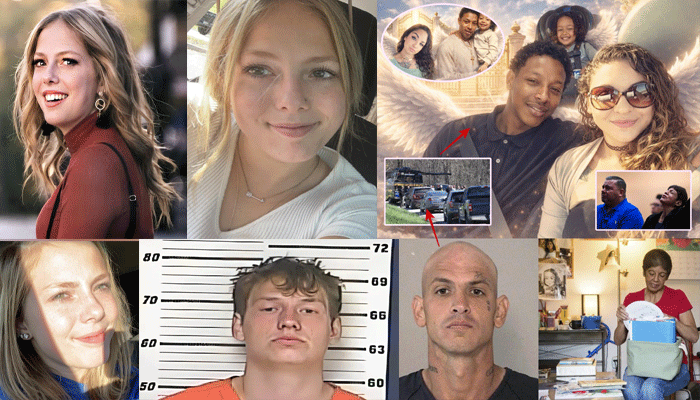
The call came in as something ordinary.
A report of a shooting, a voice on the other end saying it was an accident, something that had gone wrong in a moment no one expected.
But from the beginning, something about that night didn’t fit the story being told.
On August 9, 2023, officers arrived at a home in Garrison, Kentucky.
Inside, they found 20-year-old Kylie Marie Weitz with a gunshot wound to her face.
There was nothing left to save, and she was pronounced dead at the scene.
The house was quiet in a way that didn’t match the explanation.
Accidents carry chaos, confusion, panic—but what investigators stepped into felt different, heavier, as if something had already settled into place.
And the truth began to surface almost immediately.
The man who made the call was 23-year-old Damien Hebbeler.
He claimed it had been unintentional, something that happened in a split second, a mistake that could not be undone.
But the details would not support that version for long.
Investigators began asking questions.
They looked at the scene, the positioning, the distance, the nature of the wound, every detail that tells a story even when words try to hide it.
And the evidence pointed in one direction.
This was not an accident.
This was a deliberate act, carried out at close range, with no indication of hesitation in the moment it happened.
And the narrative began to shift.
Under pressure, Hebbeler’s account changed.
He admitted that he had pointed a loaded pistol directly at Kylie’s face.
And then he pulled the trigger.
Three simple actions.
Pointing the weapon, holding it steady, making the decision to fire.
Each step required intention, and together they formed something irreversible.
Kylie Marie Weitz was only 20 years old.
She was described as kind, full of life, deeply connected to her family, someone who brought warmth into the lives of those around her.
Her future had barely begun to unfold.
She loved sports.
Cheerleading had been a passion, something that gave her energy, purpose, a sense of belonging that carried through her teenage years.
She was more than a victim, more than a headline.
She was a daughter.
A sister.
A granddaughter whose absence would leave a silence no one could fill.
As the investigation continued, something even more disturbing came to light.
Prosecutors revealed that Hebbeler carried what he referred to as a “special bullet.”
And it was that same round that ended Kylie’s life.
Kentucky man found guilty in intentional murder of girlfriend | FOX 56 News
It wasn’t just a weapon.
It wasn’t just a moment of anger or escalation.
It was something prepared, something thought about before that night ever began.
The phrase itself carried weight.
A “special bullet” is not something associated with accident or impulse.
It suggests intention, planning, a mindset that existed long before the trigger was pulled.
Then came another detail.
Less than a year before the shooting, Hebbeler had made statements expressing that he wanted to kill her.
Words spoken in the past that suddenly became evidence of something far more serious.
Those words mattered.
Because they showed this was not just about what happened in one moment, but about what had been building over time.
And that made the case impossible to ignore.
In court, the story unfolded piece by piece.
Prosecutors laid out the evidence, the admissions, the prior statements, the weapon, the distance, the intent.
They built a narrative that left little room for doubt.
The defense tried to push back.
They questioned interpretation, raised possibilities, attempted to frame the situation as something less calculated than it appeared.
But the weight of the evidence stood firm.
At the center of it all was a single act.
A gun pointed at a face.
A trigger pulled without interruption.
The jury had to decide what to call it.
They had to look at the evidence, the admissions, the timeline, and determine whether this was an accident, a moment of recklessness, or something far more serious.
And when their decision came, it was clear.
On March 24, 2026, Damien Hebbeler was found guilty of intentional murder.
The verdict carried the weight of everything that had been presented, everything that had been uncovered.
It was a formal recognition of what had truly happened that night.
Then came the sentence recommendation.
Fifty years in prison, a number that reflects not just punishment, but the magnitude of the loss that cannot be measured.
A life taken, and another life defined by that decision forever.
For Kylie’s family, the verdict was something complicated.
It brought accountability, a confirmation that what happened would not be dismissed or minimized.
But it did not bring her back.
It never does.
No sentence, no courtroom decision, no statement from officials can restore what was lost in that moment.
Justice and healing are not the same thing.
Her loved ones remembered her in ways that went beyond the case.
They spoke about her kindness, her energy, the way she showed up for the people she cared about.
The small things that become everything once they’re gone.
Photos became memories.
Moments that once felt ordinary now carried a different weight, each one a reminder of a life that should have continued.
Each one a piece of something that ended too soon.
The case also became part of a larger conversation.
Domestic violence, warning signs, the things people say before actions follow, the moments that might be overlooked until it is too late.
Questions that surface again and again after tragedies like this.
Because the signs were there.
Statements made months before, a mindset that did not begin on the night of August 9.
And yet, like many cases, it reached its breaking point in a single irreversible moment.
Kentucky Attorney General Russell Coleman addressed the outcome.
He stated that the verdict affirmed Kylie’s life mattered and reinforced the state’s commitment to holding offenders accountable in domestic violence cases.
Words that carry both meaning and limitation.
Kylie Marie Weitz Willis, age 20
Because behind every statement is a family still grieving.
A space at the table that will never be filled again.
A future that exists only in imagination now.
Hebbeler is scheduled to be sentenced on June 5, 2026.
That date will mark another step in the legal process, another moment where the system finalizes its response to what happened.
But for those who loved Kylie, the timeline feels different.
Time did not stop.
But it changed.
It divided itself into before and after.
Before that night, when Kylie was still here.
After that night, when everything became something else.
And there is no crossing back between those two places.
The story is not just about a crime.
It is about how quickly a life can be taken, how warning signs can exist without intervention, how a single decision can ripple outward into countless others.
It is about consequences that extend far beyond one person.
A young woman is gone.
A family is left to carry that loss.
And a man now faces decades defined by what he chose to do.
There are no simple endings here.
Only the reality of what happened, the weight of it, and the lives that must continue in its aftermath.
And the memory of Kylie Marie Weitz, held onto by those who refuse to let her be reduced to just a case.