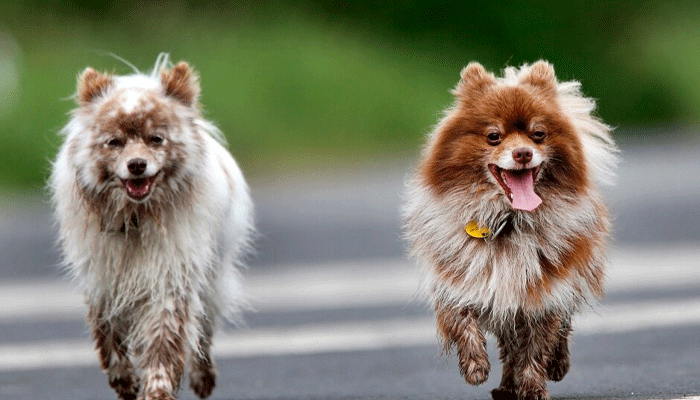
Scientists believe that in the future, this evolutionary ability of dogs could be further tested, allowing them to distinguish between truth and lies.
A new study has revealed that dogs can sometimes indicate when people are lying to them. This points to a mechanism suggesting that sensitivity to others’ thoughts is not limited only to primates (humans, monkeys, or other animals of this lineage).
During this study, which involved researchers from the University of Vienna, 260 dogs of various breeds were analyzed. The dogs were trained to follow the advice of an unfamiliar person in choosing between two bowls, one of which contained a reward for the dogs.
Initially, the dogs received the reward when they followed this person’s advice. Later, scientists mixed up the contents and introduced another human into the experiments. This second person moved the reward from one bowl to the other.
In some trials, the second person was not present during the transfer, but they still gave the dogs advice on which bowl to choose. During this process, researchers observed whether the dogs changed their behavior.
According to results published in the journal Proceedings of the Royal Society B, half of the dogs ignored the human’s advice when they saw them indicating the wrong bowl. This indicates that the dogs recognized when they were being lied to.
When the second person was absent and the bowls were switched, the dogs simply ignored the incorrect advice.
Similar experiments conducted in the past with humans under five years old, monkeys, and chimpanzees showed that children and other animals were more likely than dogs to follow the advice of someone lying.
The researchers wrote: “Consequently, our study provides the first experimental evidence that dogs can distinguish between truth and lies regarding the location of objects.”
Scientists believe that even without any formal training, pet dogs can provide humans not only with various types of information but also insight into intentions and beliefs.
However, the researchers noted that further study is needed regarding mental control in certain situations from the perspective of human communication. This would help better understand the potential thought processes of dogs when they are making decisions.
Scientists also believe that in the future, this evolutionary ability of dogs could be further explored, enabling them to differentiate between truth and lies.