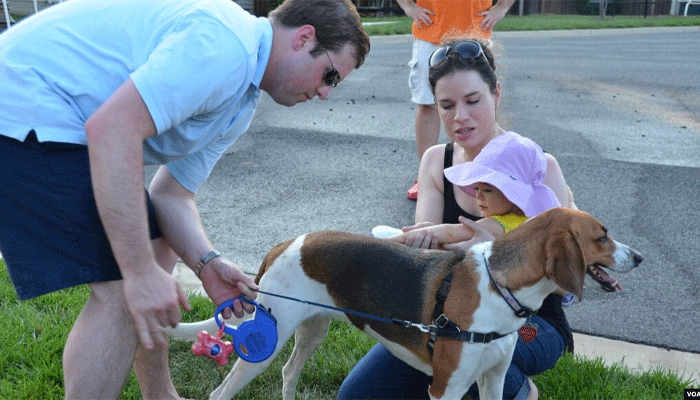
Dogs can detect the presence of cancer several years before its symptoms appear. If a dog repeatedly comes close to you and keeps sniffing a particular part of your body, you should not shoo it away. Instead, you should consult a medical specialist, as cancer may be present in that area.
In many countries around the world, dogs are already being used to detect drugs and explosives, and special trained dog units have been established within security institutions. The day is not far when you may also see dogs examining patients in various hospital departments.
This is not a joke or something to laugh about. Research in recent years has proven that dogs can detect different types of cancer. There are documented cases in which cancer could not be detected through laboratory tests, but dogs warned of its presence in advance.
The discovery of cancer detection through dogs happened by coincidence. Some cancer patients reported to their doctors and acquaintances that several years before their cancer was diagnosed, their pet dogs repeatedly sniffed the same part of the body where the tumor was later found. After several such incidents, experts began conducting experiments and discovered that dogs can recognize a specific odor of cancer that the human nose cannot detect.
Experts say that dogs have 25 times more smell-sensitive nerves in their noses than humans, increasing their sense of smell by one hundred thousand to five hundred thousand times compared to humans. According to a cautious estimate, the number of these nerves ranges from 120 million to 220 million. Interestingly, the back part of a dog’s nose contains additional smell receptors that greatly enhance its sense of smell. Moreover, the structure of a dog’s brain is different from that of humans. While the human brain relies mostly on vision to understand its surroundings, a dog’s brain depends primarily on its sense of smell. As a result, the smell-processing part of a dog’s brain is about 40 times larger than that of a human.
Scientific studies have shown that cancerous cells produce a specific type of odor. Dogs can not only smell this odor but can also distinguish it separately. With a little training, dogs can be taught to recognize and indicate the smell of cancer. However, only dogs with a strong sense of smell can perform this task, which is why specific breeds are used for this purpose.
In Berlin, a team of experts has successfully trained dogs to identify various types of cancer. These dogs can separately recognize the odors of uterine, stomach, bladder, skin, lung, and prostate cancers.
Experts report that when laboratory tests were conducted after cancer was detected with the help of dogs, cancerous cells were confirmed in 95 percent of cases. In most of these patients, the cancer was in its early stages, and symptoms would have appeared only years later.
Medical experts state that most cancers are treatable in their early stages, and patients’ lives can be saved.
Doctors were aware of this ability of dogs long before. In 1989, doctors at King’s Hospital in London wrote in a global medical journal, The Lancet, about a woman who complained that her pet dog repeatedly sniffed a mole on her leg. When the mole was tested in a laboratory, cancerous cells were found. In the years that followed, research on this topic began in countries ranging from France to California and Italy.
In a study conducted in the United Kingdom, experts collected urine samples from eight volunteers. One of them had cancer but showed no symptoms, while the remaining seven were healthy, including one person of the same age as the cancer patient. The positions of the samples were changed repeatedly, and the experiment was conducted several times. Each time, the dogs correctly identified the sample of the cancer patient. In his report, team leader Guest wrote that, considering dogs’ sense of smell, scientists should work on developing machines like an “electronic nose” that could help diagnose cancer by detecting its odor.
Whether an electronic nose can replace a dog’s nose remains uncertain. However, it can be said with confidence that in the coming years, dogs will be assisting doctors in detecting cancer.