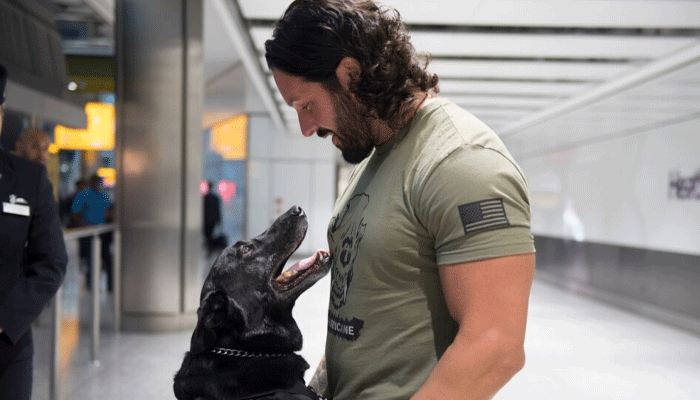
Thirteen states in the United States have officially designated a particular breed of dog—the Great Dane—as their state animal. But the matter does not end there. According to statistics from last year, there were around 90 million pet dogs in the United States, and in approximately 85 million households, at least one dog could be seen wagging its tail.
This is not limited to the United States alone. Worldwide, the dog is among the most commonly kept animals. The companionship between humans and dogs is very old. Historians say there is clear evidence that dogs were living alongside humans 14,000 years ago and helping them in hunting.
Dogs are believed to be descended from wolves, which are fierce predators. What is remarkable, however, is how the two came to trust and rely on each other in the search for food.
A newly published book has recently revealed that, in reality, this relationship is one of love. Give a dog a little affection, and it will give its life for you. Once it receives love from a particular doorstep, it becomes devoted to that place forever.
Clive Wynne, Director of the Canine Science Department at Arizona State University in Tempe and an expert on dog behavior and traits, writes in his book Dog Is Love that dogs are loving animals. We like dogs because they obey our every command. They even understand our smallest gestures. That is why training them and using them for our needs is relatively easy.
He says dogs do all this because they expect love and affection in return. Wynne adds that dogs do not merely love humans; forming close relationships with humans is part of their very nature and temperament. This is what makes dogs unique compared to other animals.
Another study shows that dogs are more intelligent and perceptive than many other animals. When their understanding is compared to that of humans, it is generally equivalent to that of a four-year-old child. However, some dogs possess the understanding of a seven-year-old child.
In the United States, great attention is paid to dog breeding, care, and medical treatment. Pet dogs are obtained from breeding farms where they are trained. Stores selling dog food and essential supplies are everywhere. Even ordinary grocery stores have a separate section for dog food.
In addition, there are facilities for bathing dogs, grooming their fur, haircuts, and even makeup. Veterinarians and animal hospitals are available in almost every neighborhood. There are insurance companies dedicated to dogs’ health and medical care. If you need to go somewhere for a few days and cannot take your pet dog along, there is little cause for concern, as special hotels for dogs also exist. And you may be surprised to learn that there are even television channels for dogs that broadcast programs tailored to their preferences.
Another book on pet dogs has recently entered the market titled Our Dogs, Ourselves. Alexandra Horowitz, head of the dog studies department at Barnard College in New York, says that issues and questions related to dogs’ rights have now begun to emerge.
Previously, Alexandra’s book Inside of a Dog became a bestseller in 2009. In her new book, she raises important questions. She says that dogs have become part of our culture, yet we have still not accepted them as living beings and instead consider them our property. She asks whether we have the right to use specific methods to control their breeding and whether we should use dogs as tools in scientific research.
Alexandra argues that in our efforts to keep dog breeds “pure,” we have adopted cruel practices. In dog nurseries, one can find puppies whose father and grandfather are the same—and this lineage can go even further. She explains that the harmful effects of this are now beginning to surface, with genetic diseases emerging in certain dog breeds.
In her book, she mentions specific genetic diseases associated with various dog breeds, which she attributes to keeping dogs within a restricted breeding pool.
However, Clive Wynne says that no matter what the situation may be, humans’ love for dogs will never diminish.