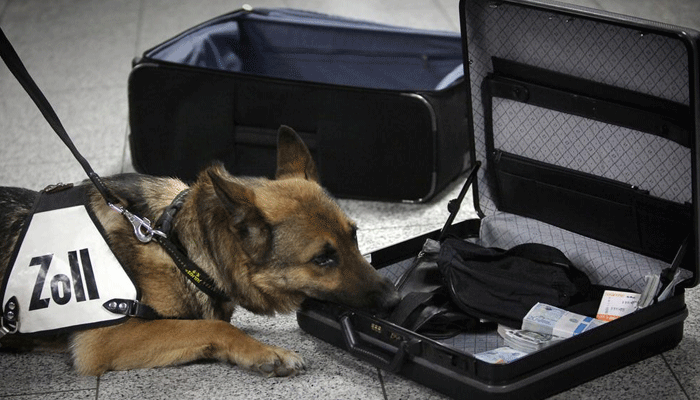
Dogs can detect drugs, currency, and even explosives simply by smelling them. Now, both the media and researchers are excited about a new ability in dogs: they can detect cancer.
For example, in 2016, actress Shannon Doherty claimed that her dog detected her breast cancer before her doctor did. Many people report similar experiences, saying that their dog’s behavior became unusual and it started pawing at the part of the body that later turned out to have cancer.
Similarly, some studies have confirmed that dogs can detect breast cancer, lung cancer, and prostate cancer. In 2006, American scientists reported a 99% success rate in detecting lung cancer through dogs. However, critics argue that human lives cannot be risked this way, as dogs are not entirely reliable.
As early as 1989, scientists had suggested that dogs’ sense of smell is so acute that it could be used to detect cancerous cells. Dogs can detect the unusual organic compounds produced by cancer and identify cancer by sniffing human breath, urine, and skin.
Professor Peter Boeker, associated with research on gas detection at the University of Bonn in Germany, said, “We do not know exactly what it is that triggers a response in dogs.” Scientists have so far failed to determine what specifically affects dogs’ sense of smell. They believe it could be a combination of different elements produced by cancer that create a unique odor detectable only by dogs.
The United Kingdom’s National Health Service (NHS) has initiated a program in this regard. Research conducted under this program showed that dogs successfully detected cancer in 93% of cases.
On the other hand, critics argue that diagnosing cancer in hospitals through dogs is a very challenging process. Training dogs for this purpose requires considerable time and money, and providing trained dogs to hospitals worldwide is practically impossible.